

Table of Contents
- Artisan Fragrance vs Designer Perfume: The Core Difference
- Ingredient Quality: Synthetic vs Natural in Perfumery
- How to Identify High-Quality Perfume Ingredients
- Creative Freedom: The Perfumer's Vision vs Brand Heritage
- The Benefits of Niche Fragrance Houses Over Mass-Market Scents
- Sourcing Sustainable Ingredients for Perfume Making
- Price, Value, and the Bridge Market Explained
- Which Fragrance Type Should You Choose?
- Frequently Asked Questions
Last Updated: September 5, 2026
Artisan Fragrance vs Designer Perfume: The Core Difference
The debate between artisan fragrance vs designer perfume brands comes down to intent: one is created to express an artist’s vision, the other is engineered to sell to the broadest possible audience. An artisan fragrance is a small-batch composition where the perfumer controls every decision, from raw material sourcing to final concentration, without a marketing team dictating the scent architecture. Designer perfumes, by contrast, are products of large fashion houses where mass-market appeal, celebrity endorsement, and distribution economics shape the final formula. At Roma Parfum, we build every scent around this artisan philosophy, blending hand-extracted oils and rare botanicals at a 40% concentration to prioritize the wearer's experience over shelf appeal.
That distinction drives everything else: ingredients, longevity, price, and how the scent behaves on your skin. Designer houses rely on synthetic molecules for batch consistency; artisan perfumers use natural extracts that vary slightly by harvest, which is a feature, not a flaw.
Ingredient Quality: Synthetic vs Natural in Perfumery
The most significant gap between artisan and designer scents is what goes inside the bottle. Designer fragrances depend on synthetic aromachemicals for two reasons: cost control and uniformity. Synthetics are cheap to produce at scale and smell identical from the first batch to the millionth. Natural ingredients, however, are expensive, fluctuate in quality, and demand skilled handling. Most designer formulas use a high percentage of synthetics to keep prices accessible and supply chains predictable.
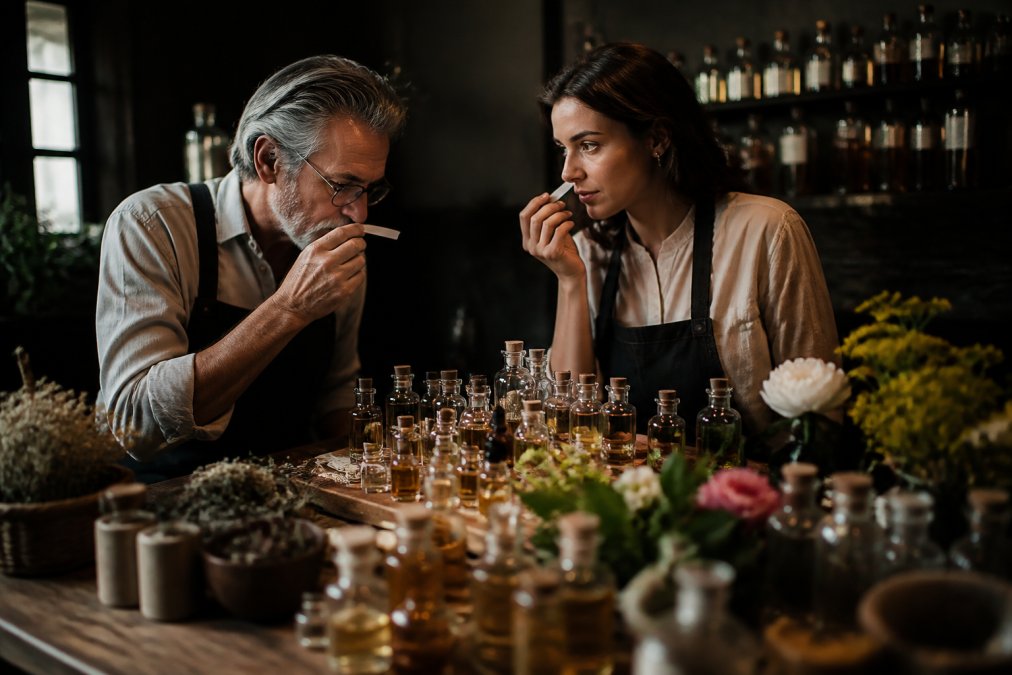
Artisan perfumers take the opposite approach. Houses like Hiram Green build entire compositions from 100% natural botanicals, while Providence Perfume Co. formulates with natural absolutes, resins, and essential oils, avoiding the synthetic musks and phthalates common in department store scents. The trade-off is real: natural ingredients produce a more complex, living scent that evolves on skin, but they cost more and require careful quality control. Roma Parfum works this way, sourcing rare botanicals and hand-extracting oils to preserve their full olfactory profile.
How to Identify High-Quality Perfume Ingredients
You don’t need a trained nose, but you need to know what to look for. High-quality ingredients reveal themselves on skin, not on a tester strip. Natural oils unfold in phases; synthetics often smell linear. If a scent smells identical at hour one and hour six, it’s likely built on aromachemicals.
Batch consistency is another clue: designer fragrances demand synthetic inputs to match every bottle, while artisan perfumers accept natural variation as authenticity. On ingredient lists, "parfum" followed by undisclosed compounds signals synthetics; look for named botanicals like ambergris or orris root. Concentration matters too: an extrait with high oil percentage outperforms an eau de toilette in longevity and projection.
Creative Freedom: The Perfumer's Vision vs Brand Heritage
Designer fragrances are constrained by brand heritage and commercial targets. A fashion house must protect its image, so scents are designed to be safe, familiar, and broadly flattering. The perfumer, often anonymous, receives a brief from marketers, "create a floral that appeals to women aged 25-45", producing results that are competent but rarely surprising. This is why so many designer scents smell similar.
Artisan perfumery inverts that dynamic: the perfumer's vision leads, and the customer follows. Creative freedom means taking risks with unusual materials or unconventional compositions without mass-market pressure. This is the heart of the artisan vs designer comparison. Roma Parfum pushes this further by having each creator develop a fragrance from their own life story, turning personal narrative into a luxury perfume.
The Benefits of Niche Fragrance Houses Over Mass-Market Scents
Choosing a niche house over a designer label delivers measurable advantages, starting with uniqueness. A mass-produced designer scent is shared with thousands in any major city; a small-batch artisan fragrance might exist in only a few hundred bottles worldwide. Scarcity transforms scent from commodity into signature.
Longevity and sillage are the second major benefit, but the reasons are more technical than most admit. The assumption that 'niche always lasts longer' is a myth. Longevity depends on three variables: concentration of aromatic compounds, molecular weight, and presence of fixatives.
Concentration is the first lever. Designer eau de parfum typically sits at 15-20% aromatic oil in alcohol. Artisan extraits, like the 40% concentration used at Roma Parfum, are a different category entirely. At that level, the oil-to-alcohol ratio changes how the fragrance evaporates from skin. Alcohol evaporates quickly, carrying lighter top notes away in the first hour. A higher oil percentage means more of the scent is composed of heavier base molecules that evaporate slowly over 12 to 36 hours.
Molecular weight is the second lever. Perfumery molecules have different evaporation rates. Light molecules like citrus terpenes (limonene, molecular weight ~136 g/mol) evaporate within minutes. Heavy molecules like macrocyclic musks or amber resins (often exceeding 300 g/mol) can persist for days. Artisan houses often select raw materials with higher molecular weights, natural ambergris, orris root, vetiver, and certain woods, because they create a longer dry-down. Designer formulas, engineered for mass appeal, frequently rely on lighter synthetic molecules that smell pleasant in the first hour but lack the molecular heft to linger.
Fixatives are the third lever. Fixatives slow evaporation by binding to skin proteins or creating a film that traps volatile compounds. Natural fixatives like benzoin, labdanum, and civet (or its synthetic substitutes) are common in artisan perfumery. Many designer fragrances omit them entirely to cut cost, which is why they fade by lunchtime.
Sillage follows the same chemistry. High oil concentration and heavy base molecules project further because they are still evaporating hours later. A synthetic-heavy designer formula may project strongly for 30 minutes, then fall flat. A high-concentration artisan extrait can linger on fabric for days; a designer eau de toilette is often gone by afternoon.
For professionals needing a scent to carry through a full workday, that gap is decisive. Niche houses also support independent perfumers, ethical sourcing, and traditional techniques that mass production is erasing. The longevity advantage is not magic, it is measurable chemistry.
Sourcing Sustainable Ingredients for Perfume Making
The environmental footprint of a fragrance depends almost entirely on how its ingredients are produced. Large-scale designer manufacturing relies on synthetic molecules and mass-cultivated botanicals, often with significant environmental costs. Sourcing sustainable ingredients for perfume making is a core principle for artisan houses, which typically work directly with growers and distilleries to secure raw materials without depleting ecosystems.
Sustainable sourcing affects quality too. A natural oil extracted from a healthy, ethically managed farm will have a richer, more complex scent profile than one harvested from industrial monoculture. Artisan perfumers often choose rare botanicals precisely because they are rare, investing in cultivation partnerships that protect biodiversity. This commitment explains part of the price gap; sustainable, hand-extracted oils cost significantly more than synthetic substitutes. When you buy from a niche house, part of your money funds better farming practices, not just a bigger marketing budget. The IFRA standards on fragrance ingredient safety govern what can be used in both artisan and designer products, but how those ingredients are grown and harvested remains a choice each house makes independently.
Price, Value, and the Bridge Market Explained
Price is where most shoppers get confused, because designer fragrances are not cheap, yet they are far less expensive than artisan extraits. That gap exists for structural reasons. Designer pricing includes massive advertising campaigns, celebrity contracts, and department store margins. Artisan pricing reflects raw material costs, small production runs, and the labor of handcrafting. Comparing them purely on price ignores what each dollar actually buys.
The 'bridge' market sits between these extremes and is more sophisticated than most articles acknowledge. It is a strategic response by designer houses to the rise of niche perfumery. As consumers sought artisan scents for uniqueness and quality, fashion houses launched 'private collections' or 'les exclusifs', fragrances borrowing niche visual language and marketing while remaining under the corporate umbrella.
These private collections share several traits: limited distribution to create artificial scarcity, higher oil concentrations (20-25% versus 15-18%), premium pricing ($200-$400 per 50ml), and marketing stories about rare ingredients or master perfumers that echo the artisan narrative.
But the bridge market has structural limits. A designer house cannot abandon its commercial constraints: the fragrance must fit the brand's portfolio and meet sales targets. The supply chain remains industrial, so ingredients are sourced for batch consistency rather than harvest character, and marketing still exists to drive volume.
To identify a bridge fragrance versus a true artisan extrait, look at concentration (20-25% oil is closer to designer eau de parfum than artisan 40%), ingredient transparency (artisan houses name botanicals and extraction methods; bridge fragrances rarely disclose full formulas), and production scale. If a 'limited' fragrance is in every Saks Fifth Avenue, it is not small-batch.
The bridge market is a reasonable entry point from designer to artisan, offering better ingredients and compositions at a price below true extraits. But it rarely matches the concentration, raw material quality, or creative risk of a house where the perfumer owns the brand.
| Factor | Artisan Fragrance | Bridge (Private Collection) | Designer Perfume |
|---|---|---|---|
| Oil concentration | High (up to 40%) | Moderate (20-25%) | Low to moderate (15-20%) |
| Ingredients | Natural, hand-extracted | Improved synthetics + some naturals | Mostly synthetic |
| Scent profile | Unique, complex | Distinctive but brand-constrained | Broadly appealing |
| Longevity | 12-36 hours | 8-12 hours | 4-8 hours |
| Availability | Small-batch, direct | Flagship stores, limited retail | Department stores |
| Price point | Premium | High ($200-$400) | Moderate to high |
| Marketing overhead | Minimal | Moderate | Massive |
The real value question is longevity and uniqueness per wear. A designer bottle that fades in four hours forces you to reapply, while a high-concentration artisan scent can last multiple days on fabric. Houses like Hiram Green start around $185 per bottle, and the pricing at Roma Parfum reflects the same premium for concentration and rare botanicals; check the website for current rates. The bridge market offers a middle path, but it is a compromise, one that serves the fashion house's need for growth as much as your need for a distinctive scent.
Which Fragrance Type Should You Choose?
Your choice depends on what you value. Choose designer for a recognizable scent, easy access, and a price point for casual rotation. Choose artisan for a signature scent no one else wears, extreme longevity, and a direct connection to the perfumer's craft.
For most enthusiasts, the decision comes down to performance. If you have bought "luxury" scents that fade by lunch, you know the frustration of paying for branding rather than substance. An artisan extrait with 40% oil concentration and hand-extracted botanicals delivers a different experience. The Roma Collective, our docuseries, documents twenty creators building their own luxury fragrance brands, proof that artisan perfumery is open to authentic stories.
The artisan fragrance movement is growing because consumers are tired of mass-market saturation and want scents with identity. Whether you are a collector of rare extraits or simply tired of smelling like everyone else, the shift toward small-batch, high-concentration perfumery rewards those who make it. At Roma Parfum, we craft every composition as a personal anthem, blending hand-extracted oils and rare botanicals into scents designed to last 36 hours. The Fragrance Foundation's market insights on niche growth confirms this appetite for authentic, story-driven scent.
Get on the mailing list and discover how a fragrance built around your own story changes what a signature scent can be.
Frequently Asked Questions
Are artisan fragrances higher quality than designer brands?
Artisan fragrances often use higher concentrations of perfume oil, like Roma Parfum's 40% extrait, and source rarer botanicals. Designer brands prioritize mass-market appeal and consistency, which can limit ingredient complexity. The quality difference isn't about one being 'better' universally, but about the goal: artisan scents aim for olfactory art and uniqueness, while designer scents aim for broad consumer accessibility. If you value rare ingredients and a complex scent composition, artisan quality will feel superior.
What defines an artisan fragrance compared to a designer perfume?
An artisan fragrance is defined by small-batch production, creative freedom, and a focus on the perfumer's vision rather than marketing trends. Designer perfumes are created by large fashion houses to appeal to a wide audience and support the brand's heritage. This results in different priorities: artisan houses often use hand-extracted oils and rare botanicals, while designer brands invest heavily in advertising and distribution networks. The scent profile and the story behind the bottle are the biggest distinctions.
Why do designer perfumes often cost less than artisan scents?
Designer perfumes benefit from economies of scale. They are mass-produced in large volumes with standardized synthetic ingredients, which keeps raw material costs down, even with high marketing spend. Artisan fragrance houses operate on a smaller scale, often using more expensive natural ingredients and handcrafted methods. The price-to-value ratio differs: with a designer scent, part of the cost covers brand prestige and advertising. With an artisan scent, your money goes toward the juice itself, including higher fragrance concentration and sourcing sustainable ingredients.
How does ingredient sourcing differ between artisan and designer perfumery?
Artisan perfumers prioritize sourcing sustainable ingredients, often building direct relationships with growers to secure rare botanicals, resins, and absolutes. This ensures quality and supports ethical practices. Designer houses typically buy synthetic and natural raw materials in bulk through global supply chains, prioritizing batch consistency and cost control over scarcity. The impact is on the final scent: artisan perfumery can deliver a more complex and dynamic olfactory profile, while designer scents offer a predictable and uniform product across every bottle sold.
Is Roma Parfum considered an artisan or designer fragrance house?
Roma Parfum is an artisan fragrance house. Based in Charleston, South Carolina, it operates as a niche perfumery focused on storytelling and premium ingredients. Each scent is crafted with a 40% oil concentration and hand-extracted oils. Unlike designer brands that follow market trends, Roma Parfum creates emotionally driven fragrances in small batches, offering unique scent profiles you won't find in department stores. This positions it firmly within the artisan category, prioritizing creative expression and ingredient quality over mass-market appeal.
This article was written using GrandRanker