

Table of Contents
- Why Do Luxury Perfumes Fade Quickly?
- Understanding Perfume Concentration Guide for Longevity
- Does Skin Type Affect Perfume Longevity?
- How to Make Perfume Last Longer Throughout the Day
- Olfactory Fatigue and Perceived Fade
- Storage and Environmental Factors That Speed Fading
- Why Investment-Grade Fragrances Deliver Real Longevity
- Conclusion
Last Updated: August 10, 2026
Why Do Luxury Perfumes Fade Quickly?
The mystery of why luxury perfumes fade quickly frustrates even devoted fragrance enthusiasts. You've invested in a premium scent, sometimes hundreds of dollars, only to find it barely detectable by mid-afternoon. The problem isn't always what you think. While mass-market fragrances fade within hours by design, luxury perfumes should deliver all-day projection. When they don't, several interconnected factors are at play: fragrance concentration, skin chemistry, environmental storage conditions, and olfactory fatigue, a phenomenon where your nose stops registering a constant scent.
At Roma Parfum, we've analyzed why customers experience such dramatic differences in longevity between fragrances at similar price points. Once you understand the science behind fragrance evaporation, molecular structure, and how your body's unique chemistry interacts with volatile compounds, you'll know exactly how to prevent premature fade.
Understanding Perfume Concentration Guide for Longevity
The single most critical factor determining how long a fragrance lasts is its concentration of fragrance oils, the percentage of aromatic compounds dissolved in alcohol. This directly controls evaporation rate and sillage, the scent trail surrounding your body.
Eau de Parfum (EDP) contains 15-20% fragrance concentration, making it the sweet spot for luxury fragrances. It delivers both immediate impact and sustained longevity, typically lasting 6-8 hours or more. Parfum extract (extrait de parfum or pure perfume) reaches 20-30% or higher, creating fragrances that linger 12-24 hours. Eau de Toilette (EDT) sits at 5-15% concentration, which explains why department store fragrances fade quickly, they're engineered for frequent reapplication, not all-day wear.
Higher oil content doesn't just make a fragrance last longer; it fundamentally changes how the scent develops on skin. With more fragrance oils present, the fragrance pyramid unfolds more slowly, allowing base notes, the heaviest, most persistent molecules, to emerge gradually rather than all at once.
How Fragrance Pyramids Affect Fade Speed
Every fragrance is structured in layers: top notes, heart notes (middle notes), and base notes. Top notes are the lightest, most volatile compounds, evaporating within 5-15 minutes. Heart notes emerge next, providing the fragrance's character for 30 minutes to 2 hours. Base notes are the heaviest molecules, remaining on your skin for hours.
Luxury fragrances with higher oil concentration feature more substantial base notes, anchoring the scent to your skin throughout the day. Mass-market fragrances skimp on base notes because they're expensive. When you perceive a fragrance as "fading," you're often experiencing the natural transition from top to heart to base notes. The scent hasn't vanished; it's evolved.
Alcohol Content and Evaporation Rate
Fragrance oils are dissolved in alcohol, typically ethanol, which acts as a carrier and accelerates initial diffusion. The alcohol evaporates first, carrying fragrance molecules into the air. Once gone, the remaining oils evaporate much more slowly.
Lower-quality fragrances use cheaper alcohol or excess water, which evaporates rapidly and takes fragrance molecules with it. Premium fragrances use high-grade ethanol and minimize water, allowing oils to persist after the alcohol disperses. A fragrance with 40% oil concentration in premium alcohol lasts dramatically longer than the same concentration in inferior alcohol.
Does Skin Type Affect Perfume Longevity?
Your skin's chemistry dramatically influences how long a fragrance lasts. The same fragrance performs entirely differently on different people because skin varies in oil content, pH balance, temperature, and microbial composition.
Oily Skin vs. Dry Skin Chemistry
Oily skin has higher sebum production. Fragrance oils dissolve readily into sebum, causing them to evaporate much more slowly. People with naturally oily skin often report fragrances lasting 10-12 hours or longer, even with lower concentrations.
Dry skin presents the opposite problem. With minimal sebum, fragrance oils sit on the skin's surface and evaporate rapidly, sometimes within 2-3 hours. The solution is straightforward: hydrate your skin before applying fragrance. Moisturized skin holds fragrance longer because water in moisturizer provides a medium for fragrance oils to dissolve into, slowing evaporation. Layering techniques, applying fragrance to damp skin or over fragrance body lotion, dramatically extend longevity.
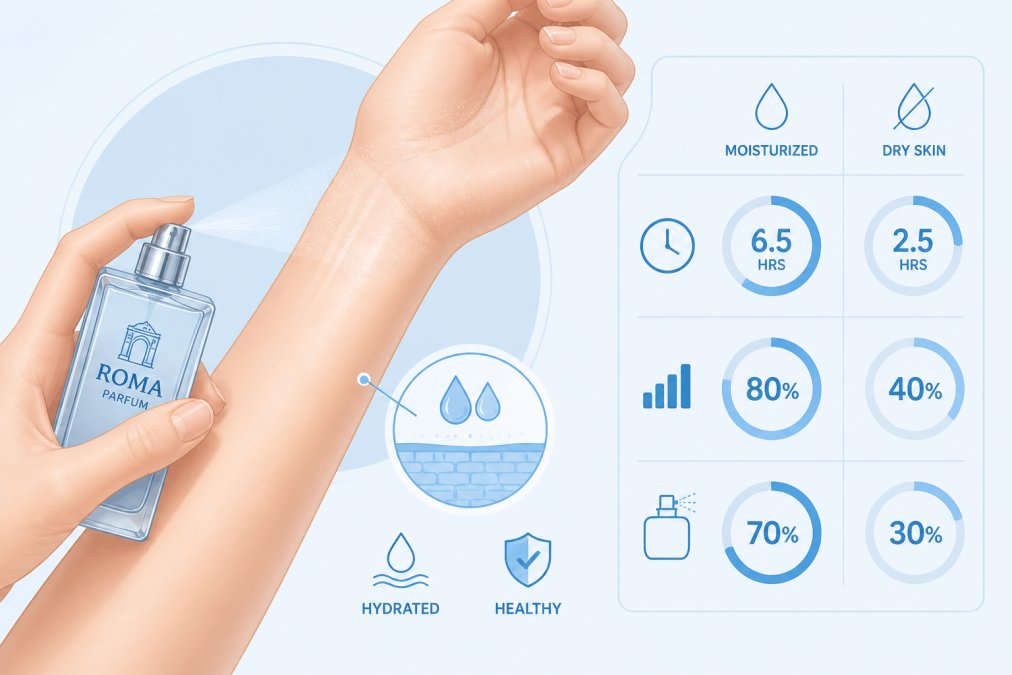
pH Balance and Sebum's Role
Your skin's pH influences how fragrance molecules interact with your skin chemistry. Skin pH typically ranges from 4.5 to 5.5 (slightly acidic). Fragrance molecules behave differently at different pH levels; some become more stable, others break down faster.
Sebum contains fatty acids that interact with fragrance molecules. When sebum levels are optimal, fragrance oils integrate into this natural oil layer, creating a slow-release effect. Your skin becomes a fragrance reservoir, dispensing scent gradually throughout the day. This explains why the same fragrance lasts vastly different lengths of time on different people.
How to Make Perfume Last Longer Throughout the Day
Understanding why luxury perfumes fade quickly is the first step. The second is implementing strategies that work with your skin chemistry. The most effective longevity techniques revolve around one principle: slow down evaporation by creating conditions where fragrance oils dissolve into your skin's natural oils and moisture.
Strategic Application on Pulse Points
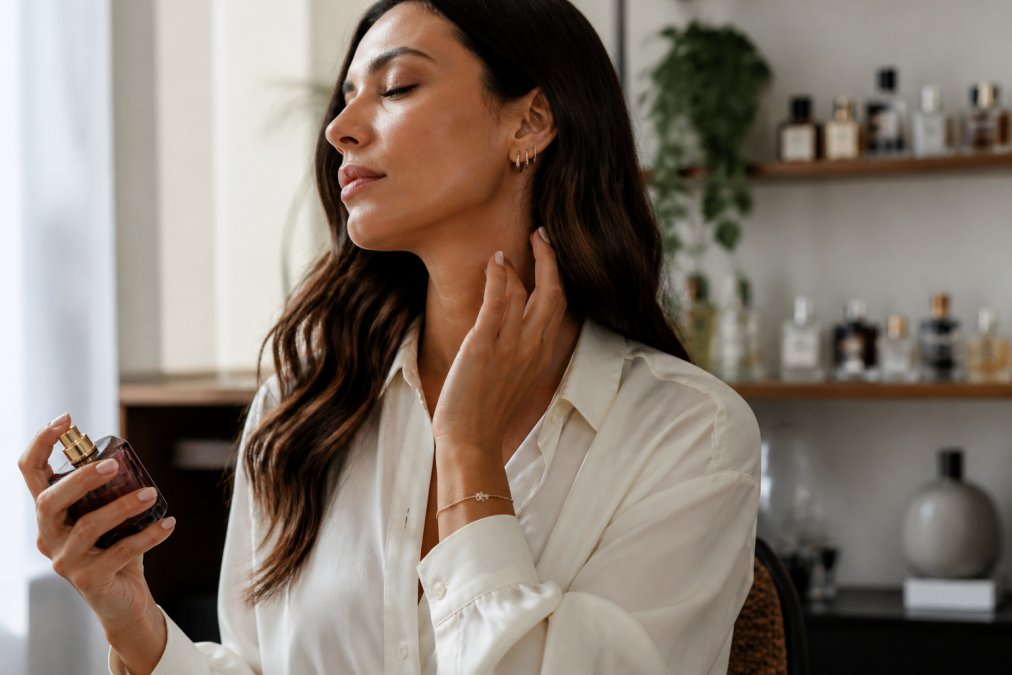
Pulse points, where blood vessels sit close to the skin's surface, generate heat that accelerates fragrance diffusion. Apply fragrance to your inner wrists, inside of elbows, behind ears, and the base of your throat. However, don't rub your wrists together after applying fragrance, this friction accelerates evaporation of top notes. Instead, let the fragrance settle for 10-15 seconds, then gently press your wrists together without rubbing.
The nape of your neck is an underutilized pulse point. The warmth combined with proximity to your body creates an ideal microclimate for longevity. Behind the ears is excellent because hair shields the fragrance from wind and environmental factors that accelerate evaporation.
Layering and Moisture Preparation
The most powerful longevity technique is layering: applying fragrance to skin already prepared with hydrating products. Moisturize immediately after showering while your skin is still slightly damp. This moisture acts as a medium for fragrance oils to dissolve into, dramatically slowing evaporation.
After your moisturizer sets (2-3 minutes), apply your fragrance. If your fragrance house offers a fragrance body lotion or oil, apply that first, then spray your eau de parfum over it. This layering technique can extend longevity from 6-8 hours to 12-14 hours or more. Apply fragrance to areas with higher sebum production when possible, the décolletage (chest and upper back) has naturally higher oil production than the wrists, making it an excellent application point.
Olfactory Fatigue and Perceived Fade
Your olfactory system is designed to detect changes in scent, not constant presence. After 15-30 minutes of continuous exposure to a fragrance, your nose stops registering it as a novel stimulus. This neurological adaptation, called olfactory fatigue or nose blindness, is not a fragrance failure.
Your fragrance is still there, still projecting, still evolving through its pyramid. Other people around you can smell it clearly. If you leave the room and return 30 minutes later, you'll smell it again because your olfactory system has reset.
Don't judge a fragrance's longevity based on your own perception. Ask people around you if they can smell it. If others detect it but you can't, olfactory fatigue is at work, not fragrance fade. Some people combat this by switching fragrances mid-day to reset their olfactory system.
Storage and Environmental Factors That Speed Fading
How you store your fragrance profoundly affects its longevity in the bottle and on your skin.
Humidity, Heat, and Light Exposure
Fragrance bottles should be stored in cool, dark places. Heat accelerates evaporation and degrades fragrance molecules. Humidity can introduce water into the fragrance, diluting it and changing its composition. Direct sunlight breaks down fragrance molecules through photodegradation.
The ideal storage temperature is 50-70°F (10-21°C). A fragrance stored properly can last 3-5 years or longer; the same fragrance stored poorly might degrade noticeably within 6-12 months. Bathrooms are the worst storage location because steam from showers introduces moisture, which dilutes the fragrance and promotes oxidation. Store fragrances in a cool closet, bedroom drawer, or dedicated fragrance cabinet away from direct light.
Environmental humidity also affects how fragrance performs on your skin. On humid days, moisture in the air can interfere with fragrance diffusion. Fragrances perform better on dry days because the drier air creates a steeper evaporation gradient, pushing fragrance molecules away from your skin.
Counterfeit Detection and Authenticity
A significant reason some "luxury" fragrances fade quickly is that they're counterfeit. Counterfeit fragrances are often diluted versions with lower fragrance concentration and inferior alcohol.
Authenticate your fragrance by examining bottle construction: luxury fragrances have weighted glass, precise labeling, and consistent batch codes. Check the fragrance itself for consistent color and clarity. Purchase only from authorized retailers. If a luxury fragrance is significantly discounted (more than 20% below retail), it's likely counterfeit or grey market stock.
If you're wearing what claims to be a 20% concentration eau de parfum but it fades within 2-3 hours, you likely have a counterfeit. Authentic luxury fragrances perform as advertised.
Why Investment-Grade Fragrances Deliver Real Longevity
Premium niche fragrances from houses like Roma Parfum invest heavily in fragrance concentration, fixative molecules, and superior alcohol quality. These fragrances aren't priced higher because of marketing; they're priced higher because raw materials cost more and the concentration is genuinely higher. A properly stored, authentic luxury fragrance will last 10-14 hours on moisturized skin, and some exceptional fragrances extend to 24+ hours.
Understanding why luxury perfumes fade quickly transforms how you approach fragrance selection and application. The issue rarely lies with the fragrance itself; it's almost always skin chemistry, storage conditions, or olfactory adaptation. By moisturizing before application, applying to pulse points strategically, layering fragrances, and storing properly, you'll unlock the full longevity potential of your collection. Get on the Roma Parfum mailing list to discover fragrances engineered for extreme longevity, with 40% oil concentration and rare botanicals that anchor scent to your skin for 36 hours or longer.
| Factor | Impact on Longevity | Solution |
|---|---|---|
| Fragrance concentration | 15-20% lasts 6-8 hours; 20%+ lasts 12+ hours | Choose eau de parfum or extrait de parfum |
| Skin hydration | Dry skin loses fragrance in 2-3 hours; oily skin retains it 10+ hours | Moisturize before application |
| Storage temperature | Heat degrades fragrance; cool storage preserves concentration | Store at 50-70°F away from light |
| Application technique | Pulse points with heat project longer than other areas | Apply to neck, wrists, inner elbows |
| Olfactory fatigue | Nose stops detecting fragrance after 15-30 minutes | Ask others if they smell it; don't rely on your perception |
The science behind fragrance longevity is accessible once you understand the key variables. According to fragrance industry standards on concentration levels, eau de parfum concentration between 15-20% is the industry standard for luxury fragrances designed for all-day wear. Research from fragrance preservation guidelines emphasizes that temperature fluctuations and light exposure are the primary degradation factors, with fragrances losing 5-10% concentration annually when stored improperly. Properly stored fragrances maintain their composition for 3-5 years.
As documented in dermatological research on skin pH and fragrance absorption, individual variation in sebum production and skin pH can create longevity differences of 300-400% for the same fragrance on different people, explaining why your friend's fragrance lasts all day while yours fades by afternoon.
Frequently Asked Questions
What is the difference between Eau de Parfum and Eau de Toilette longevity?
Eau de Parfum contains 15-20% fragrance concentration, lasting 4-8 hours on skin. Eau de Toilette has 5-15% concentration, fading within 2-4 hours. The higher fragrance concentration in Eau de Parfum means more volatile compounds remain on your skin longer, though longevity also depends on skin chemistry, application technique, and environmental factors like humidity and temperature.
How does skin chemistry affect why luxury perfumes fade quickly?
Your skin's pH balance, sebum production, and moisture level directly impact fragrance longevity. Oily skin holds fragrance molecules longer through natural sebum, while dry skin causes faster evaporation. Acidic skin (lower pH) can alter how fragrance notes develop and fade. People with higher sebum production often experience 2-3 hours longer wear time than those with dry skin, even when wearing identical luxury fragrances.
Does storing perfume in the bathroom make it fade faster?
Yes. Bathrooms expose fragrance to temperature fluctuations and humidity, which destabilize the molecular structure and accelerate evaporation. Heat and moisture break down fixatives and volatile compounds, reducing longevity both in the bottle and on your skin when applied. Store luxury perfumes in cool, dark places (ideally 60-65°F) away from direct sunlight and humidity to preserve concentration and scent profile.
Can I make my luxury perfume last longer if it fades by lunch?
Yes. Apply to pulse points (wrists, neck, behind ears, inner elbows) where body heat amplifies sillage. Layer by moisturizing skin first, hydrated skin holds fragrance longer than dry skin. Reapply mid-day to pulse points rather than re-spraying your entire body. Avoid rubbing wrists together, which breaks fragrance molecules. For extreme longevity, choose Eau de Parfum or Parfum extract over lighter concentrations, and consider layering with unscented oils or balms to extend wear time.
This article was written using GrandRanker