

Table of Contents
- Why Proper Storage Matters for Your Luxury Fragrance Collection
- The Science Behind Fragrance Degradation and Oxidation
- Ideal Temperature for Storing Fragrances
- Protecting Your Collection from Light and UV Rays
- Fragrance Collection Organization by Frequency and Type
- Perfume Shelf Life and Signs of Spoilage
- Travel Storage and Decanting Best Practices
- Choosing the Right Storage Location and Climate Control
Last Updated: August 2, 2026
Why Proper Storage Matters for Your Luxury Fragrance Collection
Proper storage protects your fragrance investment. At Roma Parfum, we understand that fine fragrances embody craftsmanship and rare ingredients. A single bottle of luxury extrait de parfum with 40% oil concentration can deliver scent for years if stored correctly, or deteriorate within months if exposed to wrong conditions.
The difference between a fragrance that maintains its olfactory integrity and one that oxidizes prematurely comes down to three factors: temperature stability, light exposure, and humidity control. Most collectors store fragrances in bathrooms, the worst possible location. Bathrooms experience constant temperature fluctuations, humidity spikes that trigger chemical reactions, and light exposure that degrades volatile organic compounds. Within six months, a fragrance stored in a bathroom can lose 20-30% of its scent profile.
Proper storage extends shelf life from 3-5 years to 10+ years. This matters because niche artisan fragrances with hand-extracted oils and rare botanicals are often difficult to replace. Once a limited edition sells out, finding another bottle becomes impossible.
The Science Behind Fragrance Degradation and Oxidation
Fragrance molecules are inherently unstable. Top notes, the lightest, most volatile compounds, evaporate naturally over time. When exposed to heat, light, or oxygen, degradation accelerates dramatically. Oxidation occurs when fragrance composition reacts with atmospheric oxygen, breaking down the delicate balance of base notes, heart notes, and top notes that define a scent's character.
Temperature fluctuations trigger the most damage. When a fragrance warms, the liquid expands; when it cools, it contracts. This repeated expansion and contraction weakens the atomizer seal, allowing fragrance to escape and oxygen to enter. After 50 thermal cycles, roughly one year in a typical bathroom, the seal becomes compromised enough that noticeable evaporation begins.
UV rays penetrate glass bottles and initiate photochemical reactions that break molecular bonds. Luxury fragrances come in dark amber or opaque glass, which blocks approximately 99% of harmful UV wavelengths. However, even dark glass offers limited protection on a sunny windowsill. Sunlight exposure for just two weeks can noticeably alter a fragrance's scent profile.
Humidity creates a separate problem. When moisture enters a fragrance bottle, it dilutes the oils and triggers hydrolysis, a chemical reaction where water molecules break down fragrance compounds. This is why keeping fragrances in sealed, airtight containers matters.
Ideal Temperature for Storing Fragrances
The ideal temperature for storing fragrances ranges between 55-65°F (13-18°C), with minimal fluctuation throughout the day. This range slows the molecular activity that causes evaporation and oxidation while remaining cool enough to prevent heat-triggered chemical reactions. Professional fragrance storage facilities maintain exactly this range.
Most homes don't maintain this temperature consistently. Central heating raises winter temperatures to 68-72°F, while summer air conditioning may cool rooms to 72-75°F. This 5-10°F variation is acceptable if gradual, but problematic if it happens daily. The real enemy is rapid temperature change, which forces the fragrance liquid to expand and contract repeatedly, stressing the atomizer seal.
If your home lacks a naturally cool space, consider a small wine cooler or fragrance-specific storage cabinet. These appliances maintain stable temperatures within 2-3°F of your target setting, eliminating daily thermal cycling.
Basements and interior closets typically maintain the most stable temperatures because they're insulated from external walls and don't experience direct sunlight. Avoid storage near exterior walls, which transmit outdoor temperature changes directly into the room.
Protecting Your Collection from Light and UV Rays
Light exposure represents the fastest way to degrade a fragrance collection. Even indirect sunlight damages fragrances because UV rays penetrate windows and bounce off walls. UV radiation excites fragrance molecules, causing them to break apart and recombine in unintended ways, typically making scents sharper and more acrid.
Dark storage locations are non-negotiable. A closed closet, cabinet, or opaque storage box blocks 95%+ of ambient light. If you display fragrances on a vanity or shelf, keep them in the darkest corner of the room, away from windows and light fixtures. Never store fragrances on windowsills, even in dark glass.
The original packaging serves a critical function beyond aesthetics. Luxury fragrance boxes are designed with light-blocking materials and protective sleeves that shield the bottle from UV exposure. Keeping fragrances in their original boxes during storage provides an additional layer of protection.
For collectors who want to display fragrances while maintaining preservation, use UV-filtering glass cabinets with LED lighting that emits minimal ultraviolet wavelengths.
Fragrance Collection Organization by Frequency and Type
Daily Wear vs. Special Occasion Fragrances
Organizing fragrances by frequency of use optimizes both preservation and accessibility. Daily wear fragrances, scents you apply 3-5 times per week, benefit from being stored separately from special occasion fragrances worn once or twice per year. This separation reduces handling of rarely-worn bottles, minimizing accidental spills and reducing the number of times you open the atomizer.
Store daily wear fragrances in a cool, dark drawer or cabinet within arm's reach of your bathroom or bedroom. Special occasion fragrances should be stored in the coolest, darkest location available, ideally a bedroom closet on an interior wall or a dedicated fragrance cabinet.
Seasonal fragrances present a unique challenge. Heavy, warm fragrances meant for winter should be kept separate from light, fresh fragrances for summer. During off-seasons, store seasonal fragrances in the coolest available location.
Inventory Management for High-Value Collections
For collectors with 20+ bottles, inventory management becomes essential. Create a spreadsheet tracking each fragrance's name, purchase date, batch code, storage location, and last opening date. Batch codes appear on the bottom of fragrance bottles and indicate when the fragrance was manufactured. Fragrances more than 5 years old should be prioritized for wearing before newer purchases, following a first-in-first-out rotation.
By tracking batch codes, you can wear older bottles before they degrade significantly, ensuring you experience each fragrance at its best. For high-value bottles worth $200+, photograph the label and batch code as backup documentation for insurance or replacement purposes.
Perfume Shelf Life and Signs of Spoilage
Most luxury fragrances maintain acceptable scent profiles for 5-10 years when stored properly. However, shelf life varies based on fragrance composition. Fresh, citrus-forward scents degrade faster than fragrances built around stable base notes like woods, musks, and resins.
Recognizing signs of spoilage prevents you from wearing degraded fragrances. The most obvious indicator is a change in color. Fresh fragrances should maintain their original hue; if a clear fragrance has turned noticeably darker or yellowed, oxidation has occurred. Smell the fragrance directly from the bottle cap before applying it to skin. Oxidized fragrances develop sharp, vinegary, or chemical notes that weren't present originally.
Check the atomizer for leaks or residue. If the bottle feels sticky or you notice fragrance residue around the atomizer seal, the seal has failed and the fragrance has been exposed to oxygen and moisture.
| Sign of Spoilage | Cause | Action |
|---|---|---|
| Darkened color | Oxidation | Use within weeks or discard |
| Sharp, vinegary smell | Chemical degradation | Fragrance profile has altered significantly |
| Sticky atomizer or residue | Seal failure | Use immediately before further oxidation |
| Cloudiness or separation | Water infiltration | Use immediately; hydrolysis is occurring |
| Significantly weaker projection | Age or improper storage | Fragrance is degrading; prioritize wearing |
Travel Storage and Decanting Best Practices
Choosing the Right Decanting Method
Decanting, transferring fragrance into smaller bottles, allows you to travel with luxury fragrances without risking your full-size collection. Never decant directly from the original bottle into a travel atomizer; instead, use a small funnel and transfer the fragrance into a clean, dry glass container first, then into the atomizer.
Glass atomizers are superior to plastic because they don't interact chemically with fragrance oils and provide better airtight seals. Decant only the amount of fragrance you'll use during your trip. Before decanting, sanitize the travel atomizer with rubbing alcohol and allow it to dry completely.
Portable Storage Solutions for Frequent Travelers
Frequent travelers benefit from dedicated travel storage solutions. A small fragrance travel case, typically 4x4 inches, holds 2-4 atomizers and protects them from breakage during transit. These cases feature padded interiors and secure compartments that prevent atomizers from shifting.
Never pack fragrances in carry-on luggage on flights. TSA regulations restrict liquids to 3.4 ounces per container in carry-on bags. Pack all fragrances in checked luggage, where they're subject to pressure and temperature changes but won't be confiscated.
For road trips, store fragrances in the coolest part of your vehicle, typically the door pockets or under-seat storage rather than the dashboard or trunk. Never leave fragrances in a parked car during hot weather.
Choosing the Right Storage Location and Climate Control
Avoiding Common Storage Mistakes
The most common storage mistake is keeping fragrances in bathrooms. Bathrooms combine three preservation hazards: temperature fluctuation from hot showers, humidity spikes that trigger hydrolysis, and light exposure from bathroom fixtures. A fragrance stored in a bathroom cabinet will degrade noticeably within 6 months compared to the same fragrance stored in a bedroom closet.
Kitchens are equally problematic. Cooking creates heat and humidity, and kitchen windows often receive direct sunlight. Bedside tables and vanities present a different problem: light exposure. Attics and garages experience extreme temperature fluctuations that degrade fragrances rapidly.
Refrigerators are sometimes recommended for fragrance storage, but this approach is problematic. While they maintain stable temperatures around 40°F, they introduce moisture and odors that can affect fragrances.
Climate-Controlled Solutions for Serious Collectors
Collectors with 30+ bottles should consider dedicated climate-controlled storage. A small wine cooler ($150-400) maintains precise temperature control and darkness while taking up minimal space. These units typically hold 20-50 bottles depending on size and maintain 45-65°F with minimal temperature fluctuation.
If a climate-controlled unit isn't feasible, optimize your existing storage by using thermal mass. Store fragrances in the center of your home rather than near exterior walls. Place fragrances in a closet on an interior wall, surrounded by other items that absorb and stabilize temperature.
Humidity control matters as much as temperature. In humid climates (above 60% relative humidity), use silica gel packets or small dehumidifiers near your storage location to reduce moisture. Monitor humidity with an inexpensive hygrometer ($10-20) to ensure your storage location maintains 30-50% relative humidity, the ideal range for fragrance preservation.
According to research from the International Fragrance Association, proper storage conditions can extend fragrance shelf life by 300-400%, transforming a fragrance that would degrade in 3-5 years into one that remains excellent for 10+ years.
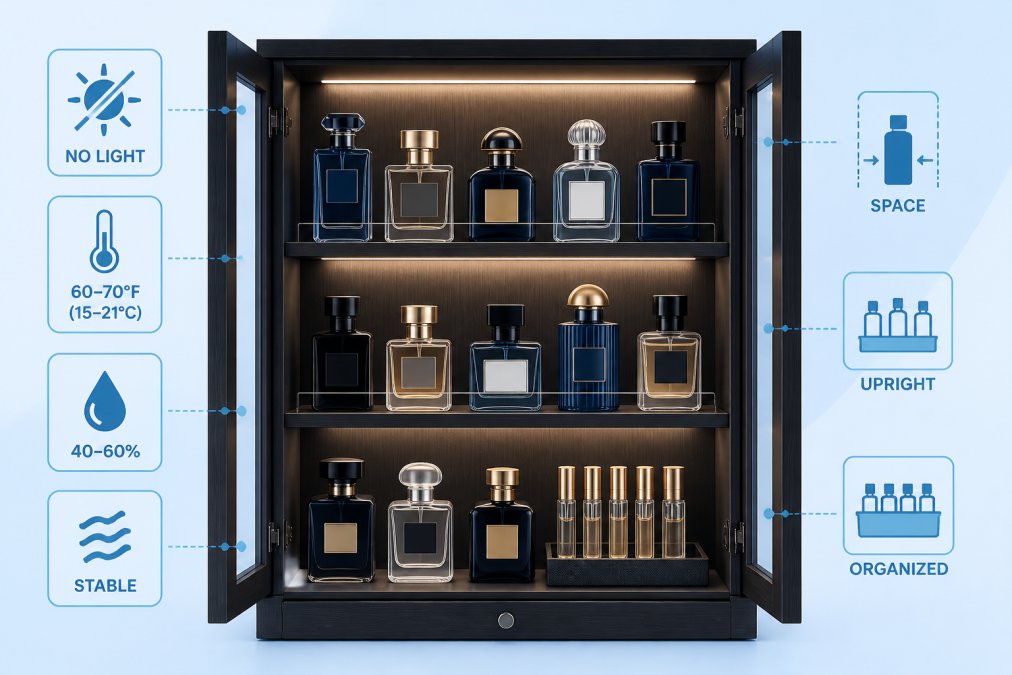
Protecting a luxury fragrance collection requires understanding how temperature, light, and humidity affect fragrance composition. The difference between fragrances that remain excellent for a decade and those that degrade within years comes down to storage decisions made today. Roma Parfum fragrances, crafted with hand-extracted oils and rare botanicals for extreme longevity and 36-hour scent projection, deserve storage that honors their quality. Implement the storage strategies covered in this guide, maintaining cool, dark, stable conditions with consistent humidity, and your collection will deliver the olfactory integrity and scent profile you purchased it for. Get started with Roma Parfum and join a community of collectors who understand that true fragrance appreciation begins with proper preservation.
Frequently Asked Questions
What is the best way to store luxury fragrance collection to prevent oxidation?
Store fragrances in a cool, dark place away from direct sunlight and heat sources. Keep bottles upright in their original packaging with tight caps sealed. Maintain temperatures between 55-75°F with stable humidity levels around 40-50%. Avoid bathrooms and kitchens where temperature and humidity fluctuate. These conditions prevent volatile organic compounds from escaping and slow chemical reactions that cause fragrance degradation and oxidation.
How long does a luxury fragrance last with proper storage and ideal temperature control?
With proper storage at ideal temperature and away from light exposure, most luxury fragrances maintain their scent profile and olfactory integrity for 3-5 years or longer. High-concentration extraits de parfum with strong base notes tend to last longer than lighter formulations. Batch codes on original packaging help track age. Sealed, unopened bottles in cool, dark conditions can preserve fragrance composition for even longer, though opened bottles degrade faster due to exposure to air and oxidation.
Should I keep luxury perfumes in their original boxes and packaging?
Yes, keeping fragrances in original packaging significantly extends shelf life by protecting against light exposure and temperature fluctuations. The box and inner packaging reduce UV ray penetration and help maintain thermal stability. Original atomizers are engineered for airtight sealing, preventing volatile organic compounds from escaping. Batch codes printed on packaging help track production dates and monitor fragrance longevity. Store boxes upright in a cool location for maximum preservation benefits.
Is it bad to store perfume in the bathroom, and what are better alternatives?
Bathroom storage is problematic because humidity from showers and baths causes temperature fluctuations and moisture exposure, leading to fragrance degradation. Humidity can compromise airtight seals on atomizers and encourage chemical reactions. Better alternatives include bedroom closets, hallway cabinets, or dedicated climate-controlled storage solutions. Choose locations away from direct sunlight, heating vents, and air conditioning units. A dark drawer or cabinet in a stable room maintains consistent temperature and humidity, protecting your collection's scent longevity and chemical stability.
This article was written using GrandRanker