

Table of Contents
- Understanding Perfume Projection vs. Sillage vs. Longevity
- Perfume Sillage vs. Projection: What's the Difference and Why It Matters
- Fragrance Concentration Guide: EDP, EDT, and Oil Content
- How to Apply Perfume at Pulse Points for Maximum Projection
- Factors That Influence Fragrance Performance: Climate, Humidity, and Olfactory Fatigue
- Best Fragrance Notes and Ingredients for Strong Projection
- Common Mistakes That Destroy Perfume Projection
- Conclusion
Understanding Perfume Projection vs. Sillage vs. Longevity
Perfume projection is how far a fragrance travels from your skin into the air. Sillage is the scent trail you leave behind after walking past someone. Longevity is how long the fragrance lasts on your skin. These three metrics are independent, a fragrance can have strong projection but weak longevity. Understanding the difference matters because what you're seeking depends on your lifestyle and expectations.
Many fragrance enthusiasts confuse these terms, leading to disappointment. You might buy a perfume expecting all-day wear only to find it fades after four hours. At Roma Parfum, we create fragrances with balanced performance across all three dimensions, scents that announce your presence without overwhelming a space, linger throughout your day, and leave a memorable trail.
The relationship between these properties is determined by fragrance concentration, molecular weight of notes, skin chemistry, and application technique. A fragrance formulated with 40% oil concentration naturally performs better across all three metrics than a lighter eau de toilette. Heavier base notes and fixatives create a more stable scent profile that resists evaporation.
Perfume Sillage vs. Projection: What's the Difference and Why It Matters
Sillage refers to the scent cloud that lingers after you've moved, what someone notices when they walk into a space you just left. Projection is the active broadcast radius while you're wearing it. A fragrance with excellent projection but weak sillage will smell powerful when someone stands next to you but won't leave a memorable trail. Conversely, strong sillage with moderate projection means the fragrance doesn't broadcast loudly in the moment, but people will notice you've been somewhere after you leave.
For professional settings, this distinction matters significantly. A scent with strong projection might be too obvious in a boardroom, while one with excellent sillage creates an elegant presence without dominating the space.
The molecular structure of fragrance notes determines sillage performance. Heavier molecules diffuse more slowly and linger longer. Lighter, more volatile compounds project immediately but dissipate quickly. Top notes create initial projection, while base notes contribute to sillage and longevity.
Climate and humidity significantly influence both metrics. In humid conditions, fragrance molecules disperse more readily, creating stronger projection. However, humidity also accelerates evaporation of lighter notes. In dry climates, projection is weaker but the fragrance evaporates more slowly, potentially extending longevity.
Fragrance Concentration Guide: EDP, EDT, and Oil Content
Fragrance concentration is the single most important factor determining how a perfume performs. It refers to the percentage of fragrance oils dissolved in alcohol and water.
Eau de Parfum (EDP) contains 15-20% fragrance oil concentration. This is the sweet spot for most luxury fragrances, providing excellent longevity (typically 6-8 hours), strong projection in the first few hours, and memorable sillage. Most high-end designer fragrances are formulated as EDPs.
Eau de Toilette (EDT) contains 5-15% fragrance oil concentration. These fragrances are lighter, fresher, and more affordable than EDPs. However, they typically last only 3-5 hours and provide noticeably weaker projection. EDTs are ideal for warm weather, office environments, or when you want to reapply throughout the day.
Extrait de Parfum (Pure Perfume) contains 20-40% fragrance oil concentration. These are the most luxurious and longest-lasting formulations, often lasting 10-12 hours or more. Roma Parfum's compositions feature 40% oil concentration, positioning them in the highest tier of fragrance luxury.
The difference in performance between an EDP and an EDT is dramatic. An EDT might fade to a skin scent after four hours, while the same fragrance in EDP form will still project noticeably at hour six.
How to Apply Perfume at Pulse Points for Maximum Projection
The most critical factor in fragrance performance is application technique. Even an exceptional EDP will underperform if applied incorrectly.
Pulse Point Application Technique
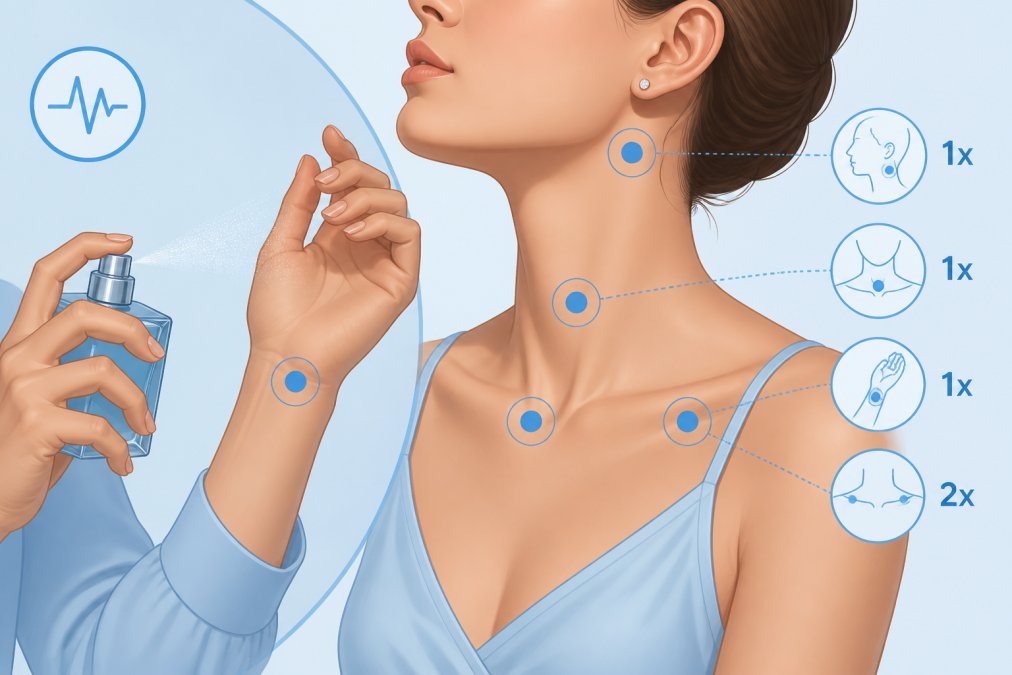
Pulse points are areas where your body generates heat: wrists, inside the elbows, behind the ears, the base of the throat, and the inner thighs. Heat accelerates fragrance evaporation, which enhances projection and diffusion. When you apply fragrance to a pulse point, warmth causes volatile compounds to evaporate more rapidly, creating a stronger scent cloud around you in the first 30 minutes.
Spray (don't dab) fragrance onto each pulse point from about 6 inches away. Dabbing or rubbing damages fragrance molecules and disrupts the carefully balanced composition. Each fragrance is designed with a specific evaporation sequence: top notes first, then heart notes, then base notes. Rubbing breaks down this sequence and flattens the scent profile.
Apply to both wrists, behind both ears, and the base of your throat. For maximum projection in professional settings, focus on the wrists and throat area. For evening wear, the inner elbows and inner thighs create more subtle, sensual diffusion.
Apply fragrance 10-15 minutes before you expect to interact with others. The fragrance needs time to settle and begin its evaporation sequence.
Skin Chemistry and Moisture Impact
Your skin's pH, natural oils, and hydration level significantly influence how a fragrance performs on you specifically. The same EDP will smell different on different people and perform differently depending on your skin condition that day.
Dry skin accelerates fragrance evaporation. If you have naturally dry skin, apply an unscented moisturizer to your pulse points before applying fragrance. The moisture slows evaporation, extending longevity by 2-3 hours.
Oily skin enhances fragrance performance. Natural sebum acts as a fixative, holding fragrance molecules in place and slowing evaporation. People with oily skin typically experience longer-lasting fragrance performance and stronger sillage.
Skin pH varies from person to person and even on different areas of your body. Fragrance molecules interact with your skin chemistry, which can shift the scent profile. There's no way to predict how a fragrance will perform on your skin until you've worn it for several hours. This is why testing before purchasing is essential.
Hydration level fluctuates throughout the day and varies seasonally. Well-hydrated skin holds fragrance better than dehydrated skin. Drinking water throughout the day improves fragrance performance.
Factors That Influence Fragrance Performance: Climate, Humidity, and Olfactory Fatigue
Environmental factors and your body's sensory adaptation dramatically influence how a fragrance performs and how you perceive it throughout the day.
Humidity and Climate Impact: In humid climates, fragrance molecules disperse more readily through the air, creating stronger projection and more noticeable sillage. However, humidity also accelerates evaporation of lighter notes. In dry climates, projection is weaker but the fragrance evaporates more slowly, potentially extending longevity. Temperature affects evaporation rate directly, warmer temperatures accelerate evaporation, while cooler temperatures slow it.
Olfactory Fatigue (Nose Blindness): After wearing a fragrance for about 30 minutes, you'll stop smelling it on yourself, but everyone around you will still smell it clearly. This is neurological adaptation, not a flaw in the fragrance. Your olfactory receptors become desensitized to constant stimulation. You can't overcome olfactory fatigue by applying more fragrance. Instead, accept that you won't smell your own fragrance after the first hour and trust that others are experiencing it fully.
This is where the distinction between projection and sillage becomes personally important. You won't perceive your fragrance's projection after about 30 minutes due to olfactory fatigue. But the sillage remains detectable to others throughout the day. Asking a friend if your fragrance is still noticeable is more reliable than trusting your own perception after the first hour.
Seasonal variations in temperature and humidity mean the same fragrance will perform differently in summer versus winter. Many fragrance enthusiasts maintain a seasonal rotation, lighter fragrances for warm months and richer compositions for cool months.
Best Fragrance Notes and Ingredients for Strong Projection
The individual fragrance notes and ingredients used in a composition directly determine how it projects and how long it lasts.
Top Notes are the lightest, most volatile compounds that evaporate first, creating the initial impression and projection but typically lasting only 5-15 minutes. Common top notes include citrus, herbs, and light florals. A fragrance with prominent top notes will have strong immediate projection but weak longevity.
Heart Notes (Middle Notes) emerge after the top notes fade and form the body of the fragrance, typically lasting 30 minutes to several hours. Common heart notes include florals, spices, and light woods. These notes determine the fragrance's character and are crucial for both projection and longevity.
Base Notes are the heaviest, least volatile compounds that emerge last and linger longest, lasting 6-12+ hours depending on concentration and skin chemistry. Common base notes include woods, musks, ambroxan, and resins. A fragrance with a strong base note structure will have excellent staying power and memorable sillage.
Synthetic ingredients like ambroxan, iso e super, and galaxolide are prized in luxury perfumery because they're incredibly stable and long-lasting. Natural ingredients like sandalwood, oud, and rare florals are valued for their complexity but are more volatile than synthetics. The best luxury fragrances balance natural and synthetic ingredients to achieve both complexity and performance.
Fixatives are ingredients added specifically to slow evaporation and extend longevity. Common fixatives include musk compounds, resins, and certain woods. A fragrance formulated with generous amounts of fixatives will naturally perform better across all three metrics.
Common Mistakes That Destroy Perfume Projection
Even with an excellent fragrance, certain mistakes will undermine its performance dramatically.
Storing fragrance in direct sunlight or heat: UV light and heat break down fragrance molecules, weakening projection and altering the scent profile. Store fragrances in a cool, dark place, ideally between 50-70°F. A bedroom closet is ideal; a bathroom is problematic because of temperature and humidity fluctuations.
Applying fragrance to dry skin: Dry skin accelerates evaporation. Moisturize your pulse points first, wait 30 seconds for the moisturizer to set, then apply fragrance.
Rubbing your wrists together: This breaks down fragrance molecules and disrupts the evaporation sequence. Spray fragrance onto your wrists and let it dry naturally.
Applying too much fragrance: Overapplication creates an overwhelming scent cloud that others find unpleasant and actually reduces longevity. The standard recommendation is 3-4 spritzes for an EDP. For an extrait, 1-2 spritzes is sufficient.
Applying fragrance immediately before leaving the house: Fragrance needs 5-10 minutes to settle and begin its evaporation sequence. Apply it before you finish getting ready.
Not accounting for skin chemistry variations: Testing a fragrance on a tester strip is not the same as wearing it on your skin. Always test on your skin and wear it for at least 2-3 hours before deciding whether it projects adequately.
Ignoring seasonal variations: A fragrance that projects beautifully in summer might feel subdued in winter. If you love a particular fragrance but find its projection lacking in cold months, consider applying it to your clothing in winter or simply accepting that seasonal variation is normal.
Achieving strong perfume projection comes down to understanding the science of fragrance concentration, application technique, and how your individual skin chemistry interacts with fragrance composition. The difference between a fragrance that impresses and one that disappoints often isn't the quality of the fragrance itself, it's how you're applying it and what you're expecting from it.
When you invest in a luxury fragrance like those from Roma Parfum, you're investing in compositions formulated with premium concentration levels and rare ingredients designed for sustained projection and longevity. But that investment only pays off if you're applying the fragrance correctly and storing it properly. Master the fundamentals of pulse point application, account for your individual skin chemistry, and adjust your expectations based on seasonal variations.
Get on the Roma Parfum mailing list to discover luxury fragrances formulated with 40% oil concentration and rare hand-extracted botanicals designed for extreme longevity and memorable projection throughout your day.
Frequently Asked Questions
How does skin chemistry affect perfume projection?
Skin chemistry directly influences how fragrance molecules interact with your body. Factors like pH level, natural oils, hydration, and body temperature all affect how quickly fragrance evaporates and projects. Oily skin tends to hold fragrance longer, while dry skin may cause faster evaporation. Moisturizing your skin before application creates a better base for fragrance molecules to diffuse, extending both projection and longevity significantly.
What's the difference between perfume sillage vs projection in practical terms?
Projection refers to how far your fragrance travels from your body, how close someone needs to stand to detect it. Sillage is the scent trail you leave behind as you move. A fragrance can have strong projection but weak sillage, or vice versa. For all-day wear, you want both: projection to announce your presence and sillage to create a memorable impression. High-concentration fragrances like eau de parfum excel at both.
Does moisturizing skin really help perfume last longer?
Yes. Hydrated skin holds fragrance molecules longer because moisture creates a barrier that slows evaporation. Apply an unscented moisturizer or fragrance-free lotion to pulse points before spraying perfume. This technique can extend longevity by several hours. Avoid heavy oils that might interfere with fragrance diffusion; lightweight, fast-absorbing moisturizers work best. This simple step is one of the most effective ways to maximize both projection and staying power.
What fragrance concentration should I choose for strong projection?
Eau de parfum (EDP) with 15-20% fragrance oil concentration offers the best balance of projection and longevity for daily wear. Eau de toilette (EDT) at 5-15% provides lighter projection, while pure perfume or extrait at 40%+ delivers extreme longevity and sillage. For professional settings or all-day wear, EDP is the sweet spot. High-concentration fragrances like Roma Parfum's 40% oil concentration maintain projection throughout a full workday without requiring reapplication.
This article was written using GrandRanker