

Table of Contents
- Why Knowing How to Identify Quality Fragrance Matters More Than Ever
- Fragrance Concentrations Explained: EDP, EDT, and Extrait
- The Fragrance Notes Pyramid: Reading Scent Evolution Like a Pro
- Perfume Longevity Factors: What Keeps a Scent Alive All Day
- How to Test Perfume on Skin the Right Way
- Natural vs. Synthetic Ingredients, Purity, and IFRA Standards
- Bottle Quality, Batch Codes, and Counterfeit Identification
- The Evaluation Framework: How to Identify Quality Fragrance Before You Buy
Last Updated: July 30, 2026
Knowing how to identify quality fragrance separates a scent that commands a room from one that vanishes by noon. At Roma Parfum, we work with this distinction every day, and the difference between a fragrance worth your investment and one that disappoints comes down to measurable, observable factors. Most buyers rely on gut instinct alone. That instinct gets expensive fast. Below, we'll show you exactly how to evaluate concentration, ingredients, longevity, packaging integrity, and counterfeit risk before you spend a dollar.
There are objective chemical, structural, and sensory markers that separate quality fragrance from mediocre compositions. The 5 evaluation layers we cover here apply whether you're shopping for a niche extrait de parfum or a designer eau de toilette.
Why Knowing How to Identify Quality Fragrance Matters More Than Ever
The niche fragrance market has expanded rapidly, and with that growth has come a flood of products claiming artisan credentials they don't have. Many consumers pay premium prices for compositions using low-grade synthetics, unstable alcohol bases, or diluted concentrations that perform like drugstore sprays.
Quality fragrance is a composition formulated with sufficient oil concentration, stable fixatives, and a coherent fragrance pyramid that evolves meaningfully on skin over several hours. A fragrance that fades within two hours hasn't delivered value regardless of its label. A scent that projects aggressively then collapses has poor fixative balance.
According to the Fragrance Creators Association's industry overview, the U.S. fragrance market continues to grow as consumers shift toward higher-concentration, longer-lasting formulations. That shift creates both opportunity and risk: more quality options exist, but so do more convincing counterfeits and misleading marketing claims.
Learning these evaluation skills means you stop relying on brand prestige alone. Prestige is a proxy for quality, not a guarantee of it.
Fragrance Concentrations Explained: EDP, EDT, and Extrait
Fragrance concentration is the single most reliable predictor of longevity and projection.
| Concentration Type | Oil Content (Approx.) | Typical Longevity | Best For |
|---|---|---|---|
| Eau de Cologne (EDC) | 2-5% | 2-3 hours | Light, casual wear |
| Eau de Toilette (EDT) | 5-15% | 3-5 hours | Daytime, office |
| Eau de Parfum (EDP) | 15-20% | 6-8 hours | Evening, moderate projection |
| Extrait de Parfum | 20-40%+ | 12-36 hours | Maximum longevity, skin-close wear |
How Oil Concentration Affects Longevity and Projection
Higher oil concentration extends wear time and changes how the fragrance pyramid unfolds. A well-formulated extrait de parfum allows base notes to emerge gradually over hours, creating scent evolution that lower-concentration versions cannot replicate. Top notes burn off more slowly, heart notes linger longer, and base notes anchor the composition to skin for the full duration.
An extrait typically projects closer to the skin, creating intimate sillage rather than a room-filling blast. This is often misread as "weaker" by shoppers accustomed to EDT projection, but it's actually a sign of refined formulation.
What 40% Oil Concentration Actually Means for Wear Time
Roma Parfum formulates at 40% oil concentration. At that level, fragrance becomes a layered experience that can linger for up to 36 hours on skin and fabric. This concentration requires hand-extracted, high-purity oils to remain stable. Cheap synthetics at that concentration would smell harsh or medicinal. The quality of raw materials becomes non-negotiable.
The Fragrance Notes Pyramid: Reading Scent Evolution Like a Pro
The fragrance notes pyramid is the structural framework perfumers use to design how a composition reveals itself over time.
Top Notes, Heart Notes, and Base Notes Decoded
Top notes are the first impression, typically lighter aromatic molecules that evaporate within 15-30 minutes. Citrus, light herbs, and ozonic accords dominate this layer. A quality fragrance opens cleanly without harsh chemical bite.
Heart notes form the core of the olfactory profile, emerging after top notes fade and persisting one to three hours. Florals, spices, and woody accords typically anchor the heart and define the fragrance's character.
Base notes are the foundation, heavy, slow-evaporating molecules like musks, resins, woods, and vanilla derivatives. In quality fragrance, base notes emerge gradually and last longest on skin.
A poorly formulated fragrance collapses at the transition between heart and base. The dry down feels flat, thin, or chemical, a direct indicator of inadequate fixatives or low-quality base materials.
What the Dry Down Reveals About Ingredient Quality
The dry down is the most honest test of fragrance quality. Anyone can formulate an impressive opening. Sustaining coherent, pleasant scent through the full dry down requires quality raw materials and skilled formulation.
Watch for these dry down warning signs: a sudden sharp chemical note, a flat musky residue with no complexity, or complete disappearance within two hours. Any of these signals a formulation issue.
Perfume Longevity Factors: What Keeps a Scent Alive All Day
Longevity is engineered through specific formulation choices you can learn to identify.
Fixatives, Alcohol Content, and Skin Chemistry
Fixatives slow the evaporation of volatile aromatic compounds. Natural fixatives include ambergris, benzoin, and labdanum. Synthetic fixatives like Iso E Super and Ambroxan are widely used in modern perfumery. Quality fragrance uses fixatives deliberately to extend wear time and smooth transitions between fragrance pyramid layers.
Alcohol content matters more than most buyers realize. High-quality perfumery alcohol is odorless and neutral, allowing the fragrance composition to shine. Lower-grade alcohol introduces its own scent, distorting the opening and potentially causing headaches.
Skin chemistry is the variable you can't control entirely. Oily skin retains fragrance longer than dry skin. Body temperature, diet, and pH all influence how fragrance performs on your specific skin. Testing on skin is non-negotiable before purchasing.
Apply a small amount to your inner wrist, wait 30 minutes, then assess the heart. Return after two hours to evaluate the base and dry down. That full arc tells you everything paper cannot.
How to Test Perfume on Skin the Right Way
Testing fragrance on skin correctly is the most underutilized skill among fragrance shoppers.
Apply a single spray or small dab to the inner wrist or inner elbow. These pulse points generate warmth that accelerates scent development. Do not rub the application point. Rubbing crushes the top notes and distorts the opening impression.
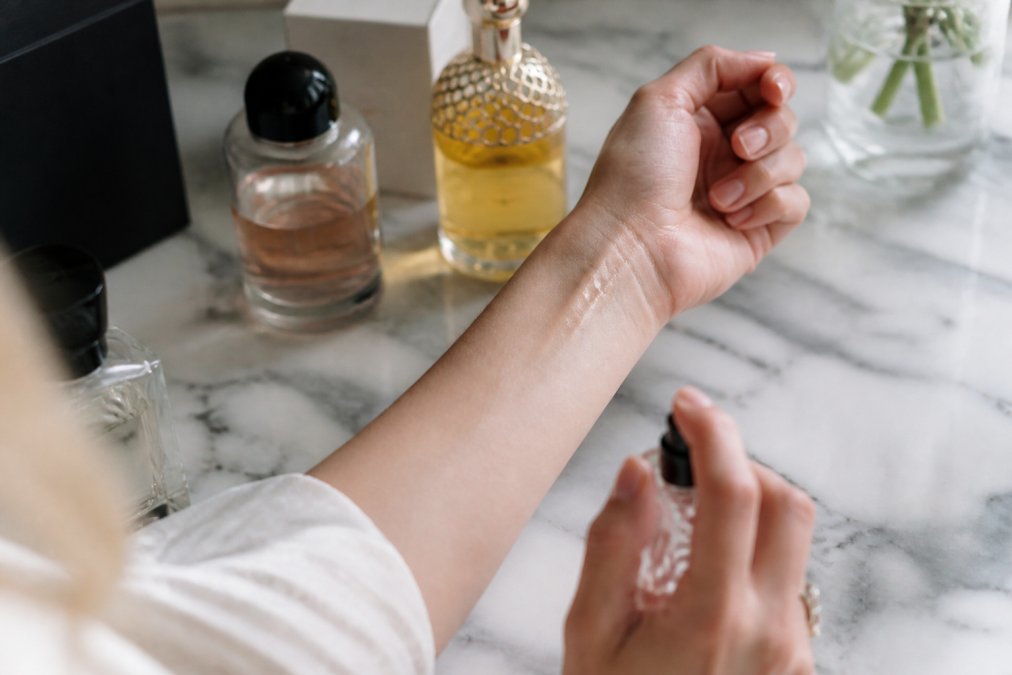
Wait at least 20 minutes before forming an opinion. The opening impression is the least reliable indicator of quality. The heart notes, which emerge after top notes fade, give you the true character of the composition.
Avoiding Olfactory Fatigue When Testing Multiple Scents
Olfactory fatigue occurs when your nose becomes temporarily unable to detect scent after prolonged exposure. It's the single biggest mistake fragrance shoppers make when testing multiple options.
Test no more than three fragrances per session, spacing applications at least 20 minutes apart. Use fresh outdoor air for two to three minutes between tests to reset your olfactory receptors. Never test on the same skin location twice in one session.
Natural vs. Synthetic Ingredients, Purity, and IFRA Standards
The natural-versus-synthetic debate in perfumery is more nuanced than most fragrance marketing suggests. Both have legitimate roles in quality fragrance composition. The real question is purity and safety compliance.
How to Spot Harmful Additives and Residue
Low-quality fragrances often use cheap diluents, artificial dyes, and low-grade synthetics to reduce production costs. These can cause skin sensitization, allergic reactions, and rapid scent degradation.
Signs of poor ingredient quality include: harsh chemical opening that doesn't soften within minutes, visible residue or oily film after application, skin irritation at the application site, and flat, one-dimensional scent lacking evolution.
The International Fragrance Association's IFRA standards set concentration limits for known sensitizers and restricted materials in fragrance compositions sold in the U.S. market. IFRA compliance is a baseline safety indicator. Reputable perfumers formulate within IFRA guidelines as standard practice.
Chemical Stability Testing and Oxidation: What Buyers Rarely Check
Chemical stability determines how fragrance performs over time, not just when freshly opened.
Oxidation occurs when fragrance compounds react with oxygen, heat, or light, degrading the olfactory profile and often producing stale, sharp, or rancid notes. Citrus-heavy and light floral fragrances are particularly vulnerable.
Check for oxidation before purchasing: examine the liquid color. Fresh fragrance should be clear to light amber. Unusual darkening, cloudiness, or a vinegary top note on initial spray suggest oxidation. Always check the batch code against the manufacturer's production date to assess storage age.
Perfume oil stability is also affected by alcohol quality and bottle seal integrity. A compromised atomizer seal accelerates evaporation and oxidation simultaneously.
Bottle Quality, Batch Codes, and Counterfeit Identification
Bottle and packaging quality are legitimate quality indicators. A well-made bottle protects fragrance composition from light and oxygen degradation. Poor sealing, cheap atomizer mechanisms, and thin glass all compromise the fragrance inside.
Evaluate the bottle by these criteria:
- Atomizer spray pattern: A quality atomizer produces a fine, even mist. Sputtering or uneven spray indicates a cheap mechanism that allows air ingress.
- Bottle weight and glass thickness: Heavier, thicker glass provides better UV protection and structural integrity.
- Cap seal: The cap should close with a firm, precise click. Loose caps allow evaporation and oxidation.
- Label quality: Crooked labels, blurry printing, or inconsistent font sizing are counterfeit indicators.
Batch codes are the most reliable counterfeit identification tool. Every legitimate production run carries a batch code, typically printed on the box bottom or bottle base. Cross-referencing this code against the production date confirms authenticity and assesses storage age.
According to the U.S. Customs and Border Protection's intellectual property rights enforcement data, fragrance and cosmetics counterfeiting remains one of the most seized product categories at U.S. ports of entry. Purchasing from unauthorized resellers significantly increases counterfeit risk.
The most reliable counterfeit indicators: missing IFRA compliance documentation, no country of origin labeling, inconsistent bottle geometry compared to official product images, and atomizer mechanisms that feel plastic or hollow rather than solid metal.
The Evaluation Framework: How to Identify Quality Fragrance Before You Buy
Use this structured approach as a pre-purchase checklist:
- Confirm the oil concentration percentage, not just the category label
- Verify IFRA compliance or ask the brand directly
- Check the batch code and production date for freshness
- Examine bottle integrity: atomizer, glass thickness, cap seal
- Test on skin, not paper, and wait the full dry down cycle
- Assess top, heart, and base notes across a minimum 2-hour window
- Check for signs of oxidation: color, clarity, opening note quality
- Verify purchase source for counterfeit risk
Common Bad Advice to Ignore When Shopping for Niche Fragrance
"More expensive always means better quality." Price correlates with quality in artisan perfumery, but the relationship isn't linear. Marketing, packaging, and brand prestige inflate prices without improving composition. Evaluate the fragrance itself against the criteria above, not the price tag.
"If it smells good on the blotter, buy it." Paper testing is a useful screening tool only. The dry down on skin is the only reliable performance test.
"Natural ingredients are always superior to synthetic ones." Many natural ingredients are unstable, allergenic, or environmentally unsustainable. Skilled perfumers use both deliberately. The quality of the formulation matters more than the source of any individual ingredient.
The real differentiator in niche fragrance is intentionality: every ingredient chosen for a specific role, formulated at concentrations that deliver on the olfactory promise. That's the standard worth holding any fragrance to.
For a deeper look at how fragrance ingredients interact with skin chemistry and IFRA safety frameworks, the Research Institute for Fragrance Materials safety database provides the most comprehensive publicly accessible reference in the U.S. market.
Most fragrance buyers spend years and significant money before developing the evaluation skills covered here. Roma Parfum was built on the conviction that transparency about concentration, ingredients, and formulation philosophy should come standard, not as an afterthought. With 40% oil concentration, hand-extracted botanicals, and compositions designed to evolve meaningfully over 36 hours, Roma Parfum gives you the foundation to apply everything in this guide and experience the difference firsthand. Get on the Roma Parfum mailing list for early access to new releases and formulation deep-dives from our perfumers.
Frequently Asked Questions
What makes a perfume high quality?
A high-quality fragrance typically features a well-balanced olfactory profile built from premium essential oils and carefully chosen synthetic compounds, strong longevity and sillage, and a clearly defined fragrance pyramid where top, heart, and base notes each evolve naturally. Compliance with IFRA standards, a stable formulation that resists oxidation, and precise fragrance concentration all signal serious craftsmanship. Artisan and niche fragrance houses tend to prioritize these factors over mass-market cost-cutting.
How can you tell if a fragrance is long-lasting?
The most reliable way to judge longevity is to apply the fragrance directly to skin, specifically the inner wrist or forearm, and track how it performs over four to eight hours. Pay attention to the dry down: a quality scent continues to project and evolve rather than disappearing within an hour. Higher fragrance concentration, quality fixatives, and compatible skin chemistry all contribute to lasting wear. Perfume oils and extraits de parfum with 30-40% oil concentration generally outlast lighter formulations significantly.
What are the different types of fragrance concentrations?
Fragrance concentrations explained simply: Eau de Cologne (EDC) contains roughly 2-5% perfume oil; Eau de Toilette (EDT) sits at 5-15%; Eau de Parfum (EDP) ranges from 15-20%; and Extrait de Parfum (perfume extract) typically runs 20-40% or higher. The higher the concentration, the stronger the projection, the richer the base notes, and generally the longer the longevity. Niche and artisan houses sometimes push beyond 40% perfume oil for extreme wear time.
How do you test a perfume correctly?
When learning how to test perfume on skin, start by spraying or dabbing a small amount on a pulse point, inner wrist is ideal, then wait at least 15-20 minutes before evaluating. This allows the top notes to dissipate and the true heart and base notes to emerge. Avoid rubbing the skin, which breaks down the fragrance molecules. Test no more than two or three scents at a time to prevent olfactory fatigue, and revisit the same spot two hours later to assess the full dry down.
How can I identify synthetic ingredients in a perfume?
Fully natural fragrances are rare and extremely expensive; most quality perfumes blend hand-extracted essential oils with synthetic compounds for stability, consistency, and depth. Synthetics are not inherently inferior, many are IFRA-approved and allow perfumers to achieve notes impossible to source naturally. Warning signs of low-grade synthetics include sharp chemical opening notes, rapid evaporation, and skin irritation. Look for transparent ingredient disclosures and IFRA compliance documentation as markers of a responsible formulation.
Do expensive perfumes always mean better quality?
Price alone does not guarantee quality fragrance. Some designer fragrances command high prices largely due to marketing and brand prestige rather than ingredient quality or concentration. Conversely, many niche and artisan houses offer exceptional olfactory profiles, rare botanicals, and high oil concentrations at comparable or lower price points than flagship designer names. The best approach is to evaluate longevity, ingredient transparency, IFRA compliance, and how the scent performs on your specific skin chemistry rather than relying on price as a proxy for quality.
What are fragrance notes and why do they matter?
The fragrance notes pyramid describes how a scent unfolds over time. Top notes are the first impression, bright, volatile, and short-lived. Heart notes emerge after 10-30 minutes and form the core character of the fragrance. Base notes appear during the dry down and define longevity and sillage, often lasting hours or even days on fabric. Understanding this layered scent evolution helps you evaluate whether a perfume's quality holds up beyond the initial spray, which is one of the clearest indicators of a well-crafted composition.
This article was written using GrandRanker