

Table of Contents
- The Copycat Business Model Behind Designer Perfumes
- How Skin Chemistry and pH Balance Change Every Scent
- Shared Ingredients: Aroma Chemicals, Esters, and Fixatives
- IFRA Standards and the Narrowing of Perfumery
- The Flanker Phenomenon and Market Testing
- Niche vs Designer Fragrance Differences in Composition
- Sourcing Sustainable Ingredients for Perfume Making
- Olfactory Fatigue: Why Your Nose Stops Noticing
- Frequently Asked Questions
Last Updated: September 15, 2026
The Copycat Business Model Behind Designer Perfumes
Walk into any department store fragrance counter and you may notice something unsettling: dozens of bottles, dozens of brands, and a striking number of scents that smell almost identical. That is not a coincidence. It is the predictable output of an industry that treats fragrance as a fast-moving consumer good rather than an art form. This guide from Roma Parfum examines why designer perfumes smell similar, and what that means for anyone shopping for a scent that actually stands apart.
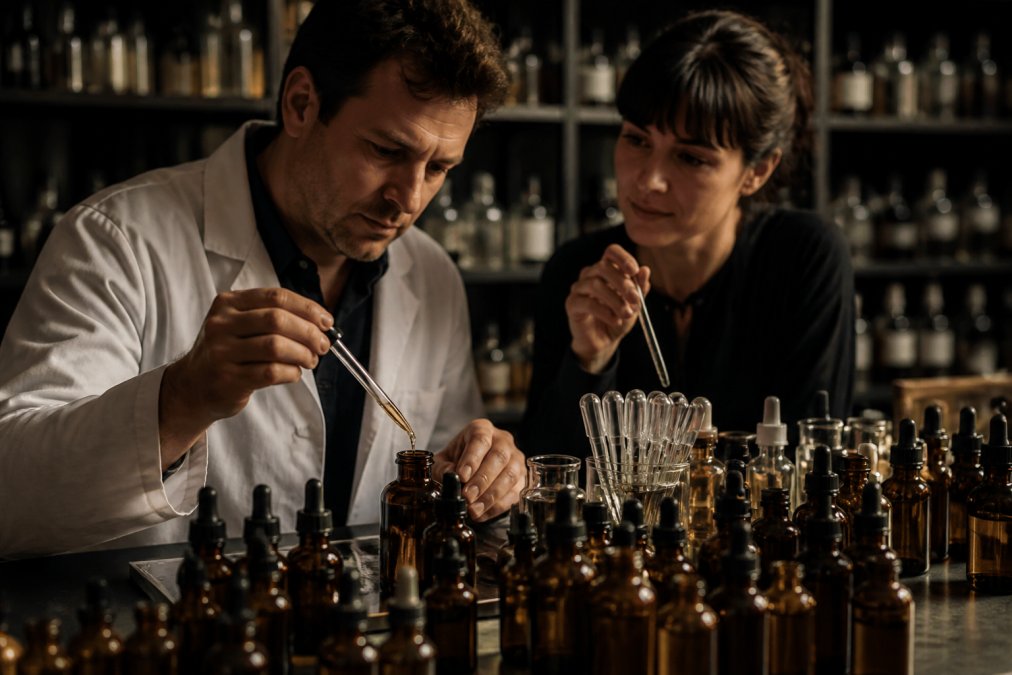
The short answer is economics. Designer houses answer to shareholders and licensing partners, and licensing deals often require a new pillar fragrance every few years to keep a brand name on shelves. A proven scent profile is a safer bet than an experimental one, so the industry recycles what already sold.
Why Focus Groups Reward Familiar Formulas
Focus groups are where originality goes to die. Panels of typical consumers are asked to rate test strips, and the safest, most recognizable compositions score highest. A scent that reminds the panel of something they already love wins. A scent that challenges them loses. Multiply that decision across every major house and you get a market where nearly everything converges on the same handful of crowd-pleasing accords: sweet amber, clean musk, and a bright citrus opening.
How Skin Chemistry and pH Balance Change Every Scent
A fragrance does not smell the same on two different people, and that is largely because of skin chemistry. Your skin's pH balance, oil production, and hydration level all interact with a fragrance's molecules and change how it unfolds. Two people can spray the same scent and get noticeably different results.
Dry skin tends to release fragrance faster, so scents fade sooner and smell sharper. Oily skin holds onto heavier molecules longer, which can stretch longevity but also amplify the base notes. This is why a perfume that smells perfect on a friend can turn sour on you. It is not the perfume changing. It is the surface it lands on.
The Skin Microbiome's Role in Scent Perception
Your skin microbiome, the community of bacteria living on your skin, also plays a part in scent perception. These microbes metabolize some of the compounds in a fragrance, subtly altering what your nose picks up. The effect is small but real, and it explains why the same bottle can smell slightly different from one day to the next.
Shared Ingredients: Aroma Chemicals, Esters, and Fixatives
Modern perfumery runs on a shared library of aroma chemicals, and the library is smaller than most shoppers assume. A handful of molecules show up in the majority of designer releases because they are cheap, stable, and versatile. Naming them makes the similarity concrete:
- Iso E Super, a velvety, woody-ambergris molecule that adds radiance and a skin-like warmth. It is one of the most widely used materials in modern perfumery and appears in a huge share of designer and niche releases alike.
- Ambroxan, a synthetic ambergris note that gives the warm, slightly mineral dry down found in countless masculine and unisex scents.
- Hedione, a jasmine-like molecule that adds lift and transparency without the cost or variability of natural jasmine absolute.
- Ethylene brassylate and Galaxolide, two of the most common musk molecules, used to build the clean, laundry-fresh base that dominates mass-market dry downs.
- Esters, fruity molecules such as those behind pear, apple, and berry accords, which give the bright opening shared by many fruity-floral launches.
When every house draws from the same supplier catalog, the raw materials push scents toward similarity before a perfumer even starts composing. Two briefs that call for "warm woody amber" will both reach for the same two or three molecules, and the result is a family resemblance that no amount of top-note tweaking fully hides.
How Fixatives Flatten the Dry Down
Fixatives are the heavier, slower-evaporating molecules that anchor a fragrance's base and extend longevity. They work by lowering the overall evaporation rate of the composition, so the scent lingers on skin instead of flashing off in an hour. The problem is that only a small number of fixatives are both effective and affordable at mass-market scale, and the same ones keep appearing.
This is why so many designer dry downs smell like relatives. Once the bright top notes burn off, what remains is largely the fixative base: a warm woody-amber, a clean musk, or a soft resin. If two fragrances share the same fixative backbone, they will smell similar for the majority of the wear, even if their openings were different.
The Cost Math Behind the Shared Palette
Aroma chemicals are also dramatically cheaper and more consistent than natural materials. A natural floral absolute can vary harvest to harvest and cost many times more per kilogram than a synthetic equivalent that performs a similar function. For a house producing millions of units, the economics push hard toward the shared synthetic palette. The result is a market where the same dozen or so molecules do most of the heavy lifting across hundreds of launches, and where the dry down, more than the opening, is where that shared palette becomes obvious.
IFRA Standards and the Narrowing of Perfumery
The International Fragrance Association (IFRA) publishes the IFRA Standards, a set of safety rules that cap or ban the use of specific fragrance materials based on skin sensitization, phototoxicity, and systemic toxicity data. The standards are enforced through the IFRA Certificate of Conformity, which fragrance houses and finished-product brands use to document that a formula complies with the current restriction limits. You can read the current standards and restriction limits directly through the IFRA standards library.
What matters for similarity is how those limits are structured. IFRA does not simply ban a material. It assigns a restriction level and a maximum concentration for each category of product, leave-on skin products, rinse-off products, and so on. A material that was once used at 2% in a fine fragrance may now be capped at a fraction of that, or restricted to categories that exclude leave-on skin entirely. When the cap drops, the perfumer has to rebuild the formula around a smaller dose of the original material plus something else that fills the gap.
Why Reformulation Pushes Houses Toward the Same Replacements
When a natural material is restricted, the industry reaches for the same short list of compliant substitutes. Oakmoss is the classic example: after restriction limits tightened, perfumers leaned on a small family of moss-like synthetics and blends to recreate the chypre effect.
The Reformulation Cycle You Can Actually Smell
The Flanker Phenomenon and Market Testing
| Factor | What It Does | Effect on Scent Similarity |
|---|---|---|
| Focus groups | Reward familiar profiles | High |
| Shared aroma chemicals | Limit the raw palette | High |
| IFRA restrictions | Cap or ban materials | Medium |
| Flankers | Recycle proven formulas | High |
| Skin chemistry | Personalizes each wear | Low (individual) |
Niche vs Designer Fragrance Differences in Composition
Sourcing Sustainable Ingredients for Perfume Making
Olfactory Fatigue: Why Your Nose Stops Noticing
Frequently Asked Questions
Is it true that all colognes smell the same?
No, but many mass-market designer perfumes share similar scent profiles because they rely on the same affordable aroma chemicals, fixatives, and base notes. Focus-group testing pushes brands toward familiar accords like vanilla, amber, and musk. Once you train your nose, you can detect real differences in fragrance concentration, dry down, and sillage between a $40 bottle and a $300 extrait de parfum.
Can you smell the difference between cheap and expensive perfume?
Often, yes. Higher-priced fragrances typically use more expensive natural materials, higher fragrance concentration, and better fixatives that extend longevity. Cheap perfumes lean on synthetic molecules that fade faster and project a flatter scent trail. However, price alone is not proof: some designer perfumes charge luxury prices while still using mass-market formulas. Pay attention to dry down, sillage, and how the scent evolves over hours.
Why do mass-market fragrances rely on similar scent profiles?
Three forces drive the similarity: cost, regulation, and risk. Aroma chemicals like iso E super and ethyl maltol are cheap and consistent, so brands reuse them. IFRA standards restrict or cap many natural ingredients, pushing formulators toward the same approved synthetics. And because focus groups reward the familiar, launching a scent that smells like a bestseller is safer than betting on something truly new.
How does skin chemistry affect how a designer perfume smells on me?
Skin chemistry shapes everything. Your pH balance, oil production, hydration, and skin microbiome interact with fragrance molecules after application, changing how top notes, heart notes, and base notes unfold. A perfume that smells sharp on one person can turn warm and sweet on another. This is why two people wearing the same designer scent can produce completely different scent trails and dry downs.
The fragrance counter rewards sameness, and that is exactly why finding a scent that feels like yours takes more than a quick sniff. Roma Parfum builds fragrances around personal stories instead of focus-group formulas, using a 40% oil concentration, hand-extracted oils, and rare botanicals for scent profiles that linger for up to 36 hours. If you are tired of every bottle smelling like the last one, get on the mailing list and be first to know when the next Roma Parfum release drops.
0 comments