

Table of Contents
- What Defines a Luxury Niche Fragrance House
- Niche vs Designer Fragrance Differences: Why Quality and Storytelling Matter
- Raw Materials, Concentration, and Longevity in High-End Perfumery
- Best Niche Perfume Brands for Beginners: Starting Your Collection
- Where to Buy Niche Perfume Samples and Discover New Scents
- Blind Buy Safety and Authentication: Protecting Your Investment
- Sustainability and Ethical Sourcing in Luxury Niche Perfumery
- The Secondary Market and Resale Value of Niche Fragrance Houses
Luxury Niche Fragrance House Reviews: A Buyer's Guide
Last Updated: August 3, 2026
When it comes to fragrance, luxury niche fragrance house reviews reveal a world entirely separate from department store counters and designer licensing agreements. These independent perfume houses craft scents with raw material concentrations reaching 40% fragrance oil content compared to the 3-5% found in mass-market eau de toilette. Roma Parfum operates within this space, creating emotionally driven fragrances through premium ingredients and artistic storytelling, a philosophy that defines the entire niche fragrance movement.
Niche perfumery isn't simply "more expensive designer fragrance." It's a fundamentally different approach where a single perfumer's vision drives every decision rather than market research and focus groups. Below, we'll explore what separates luxury niche fragrance house reviews from the noise, how to navigate blind buys safely, and where to find scents that become lasting memories.
What Defines a Luxury Niche Fragrance House
A luxury niche fragrance house is defined by three elements: artistic autonomy, raw material quality, and fragrance concentration levels exceeding industry standards. These houses reject the licensing model that dominates designer perfumery, instead owning their formulations, controlling supply chains, and maintaining creative vision across every release.
When a niche house sources Bulgarian rose absolute or Indian sandalwood, they purchase materials at prices reflecting rarity and quality. A designer fragrance might use synthetic rose molecules costing pennies per kilogram. A niche house pays hundreds of dollars per kilogram for materials delivering olfactory complexity impossible to achieve synthetically. This translates directly to genuine depth, unexpected evolution, and longevity justifying premium pricing.
Most niche fragrances launch at eau de parfum strength (15-20% fragrance concentration) as baseline. Premium lines reach extrait de parfum levels (25-40% concentration), where Roma Parfum positions itself with 40% oil concentration and hand-extracted oils delivering extreme longevity, scents lingering for 36 hours on skin rather than fading by afternoon. Each fragrance emerges from specific creative vision: a perfumer's childhood memory, geographic inspiration, or particular emotion embedded directly in composition.
Niche vs Designer Fragrance Differences: Why Quality and Storytelling Matter
Designer houses operate within constraints niche houses don't face. A luxury fashion brand needs fragrances appealing to broad audiences, performing reliably in department stores, and generating predictable revenue. This demands compromise: safer olfactory profiles, shorter longevity encouraging repurchase, and formulations prioritizing consistency.
Niche houses work oppositely. A perfumer develops a scent they believe in, then finds the audience rather than adapting composition to fit predetermined markets. This freedom produces polarizing fragrances, scents some adore and others find challenging, with no crowd-pleasing middle ground.
Designer fragrances rely heavily on synthetic molecules and accords from suppliers like International Flavors & Fragrances (IFF) or Givaudan. Niche houses layer rare natural extracts adding complexity at the cost of batch variation, a feature signaling authenticity and craftsmanship, not a flaw.
Longevity differences compound over time. A designer eau de toilette (3-5% concentration) projects 2-3 hours and fades within 6 hours. A niche eau de parfum (15-20% concentration) projects 6-8 hours and maintains presence for 12-16 hours. An extrait de parfum reaches 24-36 hours of detectable scent. For daily wearers, this means fewer bottles annually and consistent scent presence throughout the day.
Raw Materials, Concentration, and Longevity in High-End Perfumery
The olfactory pyramid, top notes, heart notes, and base notes, functions as structural foundation for every fragrance, but niche houses approach this architecture with material choices creating genuine complexity. Top notes (citrus, aldehydes, light florals) fade within 5-15 minutes. Heart notes (florals, spices, fruits) emerge as top notes fade and persist for 3-8 hours. Base notes (woods, musks, ambroxan) anchor composition and provide longevity.
In designer fragrances, progression often feels linear: bright opening, pleasant middle, fade to skin scent. In niche fragrances, progression becomes a journey. A scent might open with bergamot and black pepper, shift into rose and violet after 30 minutes, then reveal oakmoss and oud hours later. This evolution happens because the perfumer layered materials with different evaporation rates, creating intentional surprises.
Understanding Fragrance Concentration Levels
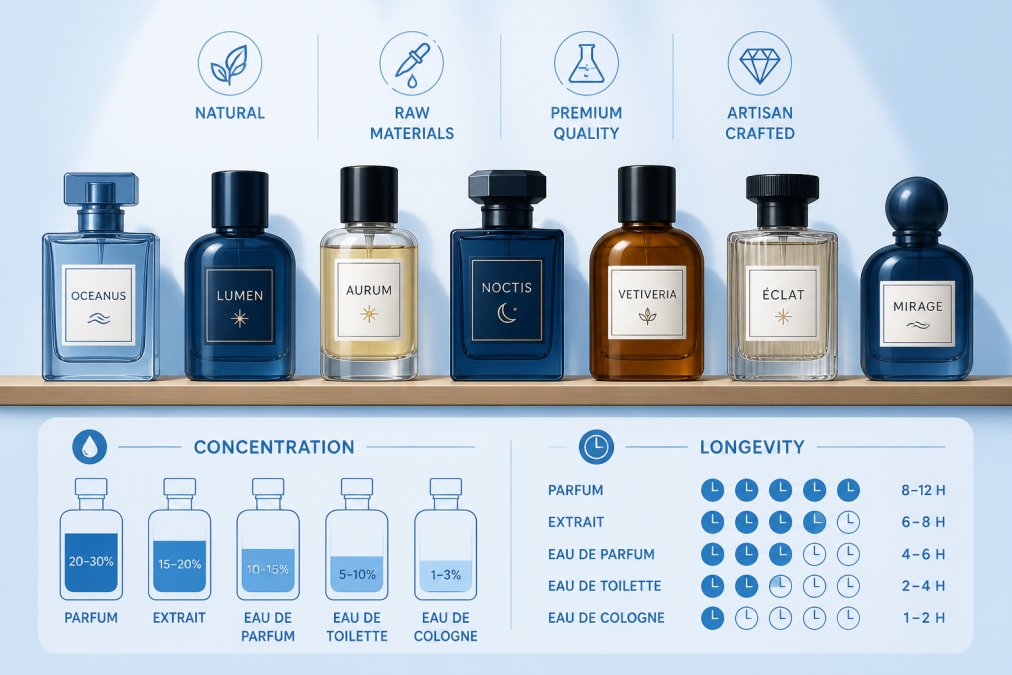
Fragrance concentration defines how much pure fragrance oil is suspended in alcohol and water, directly impacting longevity, projection (how far the scent travels), and sillage (the scent trail left in air). Standard classifications are:
- Eau de Cologne (2-5%): Light, fresh, fades within 2-3 hours.
- Eau de Toilette (5-10%): Common in designer fragrances, projects for 3-5 hours, lasts 6-8 hours on skin.
- Eau de Parfum (15-20%): Standard for niche houses, projects for 6-8 hours, lasts 12-16 hours.
- Extrait de Parfum (25-40%): Premium niche offering, minimal alcohol, intense projection, lasts 24-36+ hours.
Roma Parfum's 40% oil concentration places it at the absolute peak. This extreme concentration means minimal dilution and maximum longevity, though it requires careful application, a single spray delivers significant presence. The concentration-to-price relationship reflects material rarity: an extrait made with synthetics costs less than one made with rare natural materials.
How Sillage and Projection Impact Your Scent Experience
Sillage and projection are distinct properties often confused. Projection measures how far fragrance travels from your body. Sillage refers to the scent trail left after you move through space. A fragrance can have strong projection but weak sillage, or vice versa. Niche houses design for these properties intentionally, balancing both to create fragrances with persistent presence throughout the day.
Best Niche Perfume Brands for Beginners: Starting Your Collection
Starting a niche fragrance collection requires understanding personal preferences before committing to full bottles. The blind buy, purchasing without testing first, carries real risk because these fragrances often challenge conventional taste. A scent seeming "wrong" initially might become beloved after multiple wearings, or might genuinely not suit your chemistry.
Beginners should prioritize discovery over collection-building. Sample widely, note what resonates, then commit to full bottles only after multiple wearings. This prevents expensive mistakes and builds genuine appreciation.
For those new to niche fragrance, certain houses offer approachable entry points without sacrificing artistic vision. Imaginary Authors creates narrative-driven fragrances with accessible olfactory profiles. Zoologist uses animal themes as creative anchors, producing distinctive scents without being polarizing. Byredo balances Nordic minimalism with genuine complexity.
Roma Parfum suits beginners willing to invest in quality from the start. The focus on emotionally driven narratives means each fragrance has a clear story guiding your understanding. The 40% concentration ensures longevity justifying investment. Hand-extracted oils and rare botanicals deliver olfactory complexity distinguishing niche from designer fragrance without overwhelming newcomers.
The practical path: start with samples from multiple houses, identify 2-3 olfactory profiles you consistently gravitate toward, then explore full bottles within those categories.
Where to Buy Niche Perfume Samples and Discover New Scents
Sample acquisition is foundational to niche fragrance discovery. Full bottles cost significantly more than designer fragrances, making blind buys financially risky. Samples allow testing without commitment.
Online Retailers and Sample Services
LuckyScent operates as the gold standard for niche fragrance sampling. Their online store and physical Scent Bars in New York, Downtown Los Angeles, and Hollywood offer extensive niche selections with sample availability. According to LuckyScent's fragrance education resources, samples typically cost $4-8 each, allowing budget-conscious exploration.
Twisted Lily curates niche, indie, and natural fragrances from around the world, with samples available for many offerings. Perfumology, a Philadelphia-based boutique, provides samples with online orders and operates an in-store experience for local customers. Scent Split specializes in decanting authentic niche and designer fragrances into smaller, travel-friendly sizes.
Community Resources and Fragrance Databases
Fragrantica functions as the Wikipedia of fragrance, offering a massive database with user reviews, detailed notes, and community discussions. Fragrantica's fragrance database contains thousands of user-generated reviews revealing how fragrances perform on different skin chemistries. Basenotes provides a discussion-focused community experience with detailed, technical reviews. Parfumo combines database functionality with community features, allowing you to track your collection and create wishlists.
Blind Buy Safety and Authentication: Protecting Your Investment
A blind buy carries genuine risks in niche perfumery. These fragrances cost significantly more than designer options, and personal chemistry variations mean a scent smelling incredible on someone else might not suit your skin.
First, prioritize sample testing before committing to full bottles. Even if samples cost $20-30 total, this investment prevents expensive mistakes. Wear each sample multiple times across different days, noting how the fragrance develops.
Second, understand batch variation in niche perfumery. Natural raw materials vary seasonally, and this variation signals authentic natural material use.
Third, authenticate purchases from secondary markets. Legitimate niche fragrances have consistent bottle quality, proper labeling, and authentic batch codes. Fourth, purchase from authorized retailers when possible. LuckyScent, Twisted Lily, and Perfumology maintain direct relationships with fragrance houses, guaranteeing authenticity.
Sustainability and Ethical Sourcing in Luxury Niche Perfumery
The fragrance industry relies on raw materials sourced globally, creating sustainability and ethical considerations. Niche houses increasingly emphasize ethical sourcing and environmental responsibility.
Natural raw materials drive these considerations. Sandalwood, oud, and rose absolute come from specific geographic regions with limited production capacity. Overharvesting threatens these sources, Indian sandalwood forests have declined dramatically, and wild oud trees face extinction pressure. Responsible niche houses work with suppliers maintaining sustainable harvesting practices, often at premium prices reflecting true environmental cost.
Some houses pursue alternative approaches. Synthetic oud molecules replicate natural oud's scent profile without harvesting pressure. Synthetic rose compounds deliver rose character without requiring acres of cultivation. These synthetics allow niche houses to maintain artistic vision while reducing environmental impact, though they lack subtle complexity of natural extracts.
Transparency matters. Houses publishing supply chain information and discussing material sourcing philosophy signal genuine commitment. The secondary market also addresses sustainability. Purchasing pre-owned fragrances from collectors prevents new production while allowing access to discontinued scents.
The Secondary Market and Resale Value of Niche Fragrance Houses
Niche fragrances hold resale value in ways designer fragrances rarely do. A designer fragrance loses 60-80% of retail value immediately. A niche fragrance often retains 40-60% of original value, particularly for discontinued releases or fragrances from sought-after houses.
This resale market creates opportunities. Collectors use resale to fund new purchases, selling duplicates or fragrances that didn't work for them. This liquidity reduces financial risk of exploring new houses, if a fragrance doesn't suit you, you can recoup 40-50% through resale. The niche fragrance community maintains active buying and selling groups on Fragrantica, Basenotes, and dedicated Facebook communities.
Discontinued fragrances command premium prices. When a house discontinues a beloved scent, remaining bottles become scarce. A fragrance retailing for $150 might sell for $300-400 on secondary markets simply because it's no longer produced.
Authentication becomes critical in secondary markets. Verify seller reputation, examine bottle authenticity carefully, and ask detailed questions about storage conditions.
| Scenario | Secondary Market Value | Primary Consideration |
|---|---|---|
| Current release, widely available | 40-50% of retail | Buy new from authorized retailers |
| Discontinued, high demand | 120-200% of original retail | Consider secondary market if genuinely wanted |
| Reformulated house | 60-80% of retail | Depends on reformulation perception |
| Niche indie release, limited production | 70-100% of retail | Often holds value due to scarcity |
| Seasonal/limited edition | 80-150% of retail | Depends on how limited the release was |
Building a niche fragrance collection that brings genuine joy requires patience, community engagement, and willingness to explore beyond familiar territory. The luxury niche fragrance house reviews you'll encounter across Fragrantica, Basenotes, and fragrance communities provide starting points, but your personal chemistry and preferences ultimately determine what becomes a signature scent. Roma Parfum's commitment to emotionally driven fragrances with 40% oil concentration and hand-extracted oils delivers the extreme longevity and unique scent profiles defining serious niche perfumery. Explore samples first, engage with the community, and let your collection evolve naturally from genuine discovery rather than chasing trends.
Frequently Asked Questions
What defines a luxury niche fragrance house, and how is it different from mass-market perfume?
A luxury niche fragrance house prioritizes artisanal craftsmanship, limited production runs, and complex scent compositions over mass appeal. Unlike designer fragrances formulated for broad commercial markets, niche houses use higher fragrance concentrations (often 40% oil or more), rare botanical ingredients, and hand-extracted oils. The olfactory profile is typically more intricate, with pronounced top notes, heart notes, and base notes that evolve over time. Niche houses often emphasize storytelling and the perfumer's artistic vision rather than celebrity endorsement or marketing budgets.
Are niche fragrances worth the investment compared to designer scents?
Niche fragrances justify their premium pricing through superior longevity, projection, and sillage. A luxury niche fragrance with 40% oil concentration can last 36+ hours on skin, whereas many designer fragrances fade by afternoon. The olfactory experience is also more nuanced, revealing different scent layers throughout the day. However, the value depends on your priorities: if you prioritize extreme longevity, rare ingredients, and unique compositions, niche fragrances deliver measurable quality differences. If you prefer mainstream appeal and lower price points, designer options remain viable.
Where can I safely sample luxury niche fragrances before committing to a full bottle?
Several retailers specialize in niche fragrance samples. LuckyScent offers dabber samples ($4-$8) and operates physical Scent Bars in NYC and Los Angeles. Scent Split provides authentic decants in travel-friendly spray atomizers. Perfumology and Twisted Lily include samples with online orders. Fragrantica, Basenotes, and Parfumo offer free community reviews and fragrance databases to research scent profiles before purchasing. For blind buy safety, start with 2-3ml samples to test compatibility with your skin chemistry before investing in a full bottle.
How do I authenticate a luxury niche fragrance and avoid counterfeit products on the secondary market?
Verify authenticity by purchasing from authorized retailers like the brand's official website, established boutiques such as Osme Perfumery or Perfumology, or reputable online retailers. Examine bottle construction, label printing quality, and packaging details against official product images. Counterfeit fragrances often have inconsistent labeling, poor spray mechanisms, or incorrect olfactory profiles. On secondary markets, request photos of batch codes and purchase from sellers with established reputations. Check fragrance databases like Fragrantica to confirm the scent's expected composition before buying secondhand.
What role does sustainability and ethical sourcing play in choosing a niche fragrance house?
Many luxury niche houses differentiate themselves through transparent sourcing of rare botanicals and sustainable practices. Research whether a house sources ingredients from fair-trade suppliers, uses responsibly harvested natural oils, or supports specific regions known for fragrance materials. Some independent perfumers emphasize artisanal production methods and minimal waste. While not all niche houses publicly detail sustainability practices, the smaller scale of niche production typically means less environmental impact than mass-market fragrance manufacturing. Request information directly from the brand about their sourcing ethics before purchasing.
This article was written using GrandRanker