

Table of Contents
- What You'll Need Before You Test Perfume Scent at Home or In-Store
- Fragrance Notes Explained: Top, Heart, and Base Notes
- Skin Chemistry and Perfume: Why the Same Scent Smells Different on Everyone
- Step-by-Step Perfume Testing Tips to Avoid Costly Mistakes
- Perfume Samples vs Full Bottle: Which Should You Buy First?
- How to Test Luxury Perfume Scent Across Seasons and Moods
- Troubleshooting a 'Bad' Scent: When to Trust Your Nose and When to Wait
- Your Personal Fragrance Testing Tracker (Printable Checklist)
Last Updated: July 31, 2026
Knowing how to test luxury perfume scent properly is the difference between a fragrance that becomes your signature and one that sits unopened on a shelf. Roma Parfum has worked with fragrance creators and collectors who understand that true scent evaluation takes patience, method, and knowledge of how fragrance behaves on skin. Below, we'll walk you through exactly how to test luxury perfume scent at every stage, from the first blotter strip to the final dry down hours later.
What You'll Need Before You Test Perfume Scent at Home or In-Store
Good preparation separates serious fragrance evaluation from impulse decisions. Before you begin, gather these essentials:
- Blotter strips (also called mouillettes)
- A small bag of whole coffee beans
- Unscented skin moisturizer
- A fragrance testing journal or printable tracker
- Fragrance samples or discovery kit vials
- Clean, unscented skin
The coffee bean reset doesn't neutralize olfactory fatigue as myth suggests; it gives your nose a familiar, neutral reference point that briefly interrupts scent memory. According to Smell & Taste Treatment and Research Foundation resources on olfactory science, the olfactory system fatigues quickly under continuous stimulation, which is why spacing matters more than any reset trick.
Test no more than four to five fragrances in a single session.
Fragrance Notes Explained: Top, Heart, and Base Notes
Fragrance notes are individual scent layers that reveal themselves sequentially as perfume evaporates on skin.
Top notes are the opening impression, light, volatile molecules like citrus or herbs that evaporate within five to fifteen minutes. They're designed to attract attention, not represent the fragrance.
Heart notes (also called middle notes) form the core character. Florals, spices, and soft woods dominate this stage, emerging after top notes fade and lasting twenty minutes to an hour.
Base notes are the foundation. Rich materials like musks, resins, ambers, and woods anchor the composition. They're what you smell hours after application and determine longevity and sillage.
Understanding this structure is essential to serious fragrance evaluation. A perfume that smells sharp on first spray may open into something extraordinary once heart notes develop.
Why Dry Down Is the Most Honest Part of Any Fragrance
Dry down is when a fragrance has fully settled onto skin and base notes dominate. It's the most reliable indicator of how a perfume will actually smell throughout the day.
Most people never reach it. They spray, smell top notes, and purchase based on the most fleeting part of the composition. Dry down, typically beginning forty-five minutes to an hour after application, is where a fragrance either earns its price point or fails to justify it.
High-concentration fragrances, particularly extrait de parfum formulations, have especially complex dry downs because aromatic material density creates longer, richer development. This is where artisan perfumery separates itself from mass-market production.
Skin Chemistry and Perfume: Why the Same Scent Smells Different on Everyone
Skin chemistry is the single most overlooked variable in perfume testing. Your skin's pH levels, moisture content, temperature, and natural microbiome all interact with fragrance molecules. Slightly acidic skin amplifies certain notes while suppressing others. Dry skin absorbs fragrance faster, shortening longevity. Oily skin holds scent longer and projects more.
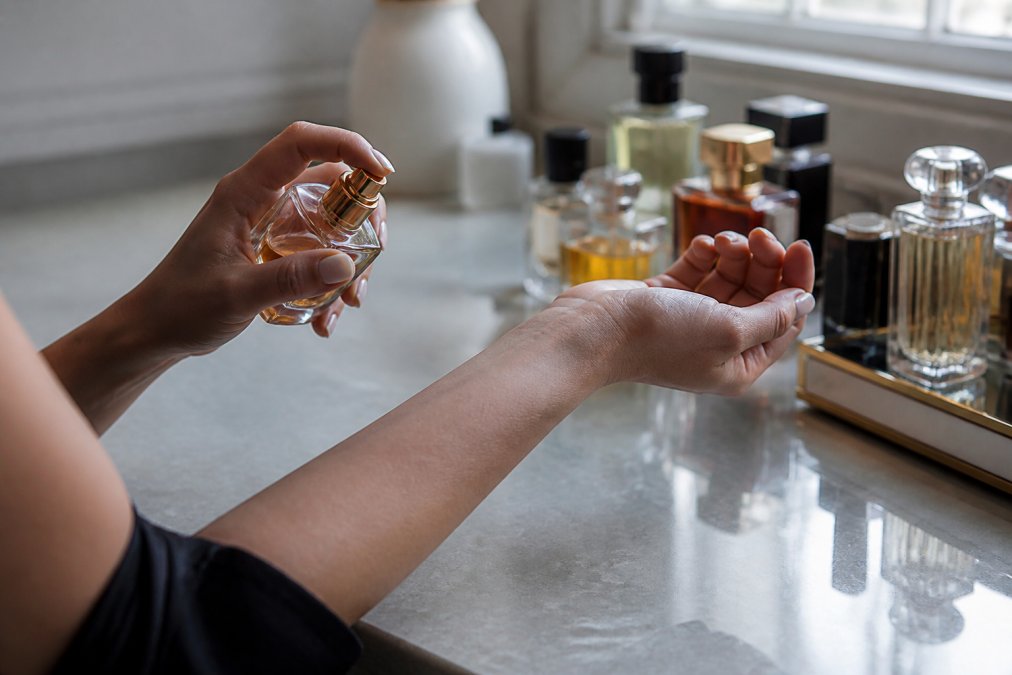
This is why testing on blotter strips alone is never sufficient for a final purchase decision. A blotter tells you about the fragrance in isolation. Your skin tells you what it becomes in conversation with your biology.
According to research on skin pH and fragrance interaction from the International Fragrance Association, the interaction between skin chemistry and fragrance compounds is well-documented. A skilled perfumer builds compositions that perform across skin types, but individual variation is always a factor.
Always test on skin before committing to a full bottle.
Pulse Points That Maximize Sillage and Longevity
Pulse points are areas where blood vessels sit close to the skin surface, generating warmth that amplifies fragrance projection. The best pulse points are the inner wrists, base of the throat, behind the ears, inner elbows, and behind the knees.
Heat accelerates evaporation, increasing sillage during the first few hours. For base-heavy, high-concentration fragrances, applying to the chest creates slower, more intimate projection that lasts through the day.
Step-by-Step Perfume Testing Tips to Avoid Costly Mistakes
Structured testing protects you from expensive mistakes. Use this sequence every time you evaluate a new luxury fragrance:
- Start with a blotter strip test for baseline impression
- Wait five minutes, then smell again to assess heart note development
- Apply a small amount to one inner wrist only
- Wait fifteen minutes before forming any opinion
- At forty-five minutes, assess the dry down on skin
- Note the sillage: how far does the scent project?
- Check longevity at three-hour and six-hour marks
- Record impressions in a testing journal before moving to the next fragrance
This sequence applies whether testing at home with samples or at a counter. The discipline of waiting separates collectors from impulse buyers.
How to Use a Blotter Strip the Right Way
Hold the blotter strip two to three inches from the bottle and spray or dip once. Do not oversaturate.
Smell immediately for top notes, then set aside for five to ten minutes. Pick it up again and smell from about an inch away. This second evaluation gives a clearer read on heart notes and overall accord.
The blotter tells you whether a fragrance is worth applying to skin. Nothing more.
How to Beat Olfactory Fatigue When Testing Multiple Scents
Olfactory fatigue is the temporary inability to distinguish scents after prolonged exposure. It's why your nose "goes blind" after testing three or four fragrances quickly.
To minimize olfactory fatigue:
- Limit active testing to four fragrances maximum per session
- Space each evaluation by at least ten minutes
- Step outside for fresh air between fragrances
- Smell the crook of your own elbow as a reset
- Avoid wearing any fragrance yourself during testing
Nose blindness is responsible for more bad fragrance purchases than any other single factor.
Perfume Samples vs Full Bottle: Which Should You Buy First?
Always buy samples before committing to a full bottle of any luxury fragrance. This is the only rational approach to a category where prices reflect rare ingredients, artisan formulation, and concentration levels that make every drop count.
| Testing Stage | Tool | Time Required | Purpose |
|---|---|---|---|
| Initial evaluation | Blotter strip | 0-15 minutes | Top and heart note preview |
| Skin compatibility | Sample vial on wrist | 45-90 minutes | Dry down and chemistry check |
| Longevity test | Sample vial over full day | 6-12 hours | Sillage, projection, staying power |
| Full bottle purchase | Discovery kit or single sample | 2-3 wear sessions | Final confirmation before investing |
Discovery kits and sample sets exist for this reason. Many niche fragrance houses offer them as the intended first step in the purchase process. A discovery kit allows you to test multiple fragrances from a line across different days and moods before deciding which becomes permanent.
How to Properly Store Fragrance Samples Between Tests
Fragrance samples degrade faster than full bottles because smaller volume is more vulnerable to air exposure, light, and temperature fluctuation. Store samples in a cool, dark drawer away from direct sunlight and heat sources.
Keep sample vials upright to minimize contact between fragrance and cap seal. Avoid storing them in a bathroom, where humidity and temperature swings accelerate breakdown. A bedroom drawer or dedicated fragrance box is ideal.
Properly stored samples remain accurate for testing for several months.
How to Test Luxury Perfume Scent Across Seasons and Moods
The most underrated variable in fragrance testing is context. A fragrance that feels heavy indoors in July may become a perfect evening scent in October. Testing across different seasons gives a far more complete picture of a fragrance's versatility.
Heavy, resinous base notes and warm spice accords perform best in cooler months when ambient temperature slows evaporation and keeps fragrance close to skin. Light aquatics, citrus-forward compositions, and green florals project more naturally in warmer months when heat amplifies brightness.
Test any fragrance you're seriously evaluating in at least two different temperature conditions before purchasing a full bottle. A fragrance family that works in spring may not serve you the same way in winter.
According to fragrance guidance from the Fragrance Foundation, seasonal context is a recognized factor in how consumers experience and bond with specific scent profiles, which is why many collectors maintain separate warm-weather and cool-weather fragrance wardrobes.
The Psychological Impact of Scent: Why Emotion Matters in Testing
Scent is the only sense with a direct neural pathway to the limbic system, the brain region responsible for memory and emotion. A fragrance that triggers a strong emotional response during testing is doing something no other sensory input can replicate with the same immediacy.
Your emotional state during testing affects your evaluation. Testing a fragrance when stressed, distracted, or in an unfamiliar environment can produce different results than testing in a calm, familiar setting. The most accurate test is one where you're relaxed and present.
A fragrance which initially seems unremarkable may reveal itself over time as deeply connected to a specific memory or mood. Some of the most loyal fragrance relationships begin with a neutral first impression that deepens with repeated wear.
Troubleshooting a 'Bad' Scent: When to Trust Your Nose and When to Wait
A fragrance that smells wrong on first contact isn't necessarily bad. Here's how to diagnose what's happening:
If it smells sharp, chemical, or harsh in the first five minutes: You're smelling the alcohol carrier and top notes. Wait.
If it smells flat or faint after thirty minutes: Your skin chemistry may be absorbing the fragrance unusually fast. Try applying to the base of the throat instead of the wrist. Apply unscented moisturizer first to create a better base.
If it smells different from what you expected based on fragrance family description: Skin chemistry is doing its job. The same accord can read as warm and woody on one person and cool and green on another.
If it genuinely smells wrong after the full dry down: Trust your nose. Not every fragrance is compatible with every person's chemistry. Move on.
When you've tested three or more fragrances in the same session, always wait before deciding. Olfactory fatigue is almost certainly distorting your perception. Reset, rest, and test again the next day.
Your Personal Fragrance Testing Tracker (Printable Checklist)
Use this tracker for every serious fragrance evaluation.
Fragrance Testing Record
- Fragrance name and concentration (eau de parfum, extrait, eau de toilette)
- Date and time of test
- Season and approximate temperature
- Application method: blotter only / blotter + skin / skin only
- Pulse point used
- Top note impression (0-5 minutes):
- Heart note impression (15-30 minutes):
- Dry down impression (45-90 minutes):
- Longevity rating at 3 hours: poor / moderate / strong / exceptional
- Longevity rating at 6 hours: poor / moderate / strong / exceptional
- Sillage: intimate / moderate / strong / loud
- Emotional response: positive / neutral / negative / unexpected
- Fragrance family: floral / woody / oriental / fresh / chypre / fougère / gourmand
- Would you wear this to: work / evening / casual / special occasion
- Skin chemistry interaction: performed as expected / amplified / muted / changed significantly
- Final verdict: pass / hold / purchase
Run through this checklist across at least two separate wear sessions before committing to a full bottle. The second test often produces different results than the first, especially for complex, high-concentration formulations where maceration depth takes time to fully reveal itself.
Choosing a luxury fragrance without proper testing is how collectors end up with bottles they never open. Roma Parfum creates extrait de parfum formulations with a 40% oil concentration using hand-extracted oils and rare botanicals, which means the full character of each composition only reveals itself through patient, structured evaluation over multiple wear sessions. The scents are built to linger for up to 36 hours, so the testing process outlined here is exactly how you find the one that becomes yours. Get on the Roma Parfum mailing list to access new releases, discovery kit availability, and exclusive early access to The Roma Collective fragrance series.
Frequently Asked Questions
How long should you test a perfume before buying a full bottle?
When learning how to test luxury perfume scent properly, plan to wear a fragrance for at least 6 to 8 hours across two or three separate days. This lets you experience all three note stages, top, heart, and base, as well as how the scent performs on your unique skin chemistry throughout the day. A single sniff in a store is never enough to evaluate longevity, sillage, or how well the dry down suits you.
Where is the best place to test perfume on your skin?
The most effective pulse points for testing are the inner wrists, the inside of the elbows, and the base of the throat. These areas generate natural warmth that activates fragrance development and amplifies projection. Avoid rubbing your wrists together after applying, this breaks down the top notes prematurely and distorts your reading of the scent profile. Apply, wait, and let the fragrance evolve on its own.
How many perfumes should you test at once to avoid nose blindness?
Limit yourself to three fragrances per testing session to prevent olfactory fatigue, sometimes called nose blindness. After three scents, your olfactory receptors become temporarily saturated and lose their ability to distinguish differences accurately. Between each fragrance, smell something neutral, ground coffee beans or plain wool fabric both work well. If you're using perfume samples vs a full bottle, spacing tests across different days gives the most reliable results.
Why does perfume smell different on my skin than it did in the store?
Skin chemistry and perfume interact in deeply personal ways. Your skin's natural pH levels, moisture content, diet, and even body temperature all influence how a fragrance develops after application. An eau de parfum that smells floral and fresh on a blotter strip may lean warmer and spicier on your skin. This is why testing on skin, not just a blotter, is essential before committing to any luxury fragrance purchase.
What are fragrance discovery kits and are they worth it for testing luxury scents?
Discovery kits, curated sets of perfume samples, are one of the smartest ways to test luxury perfume scent before investing in a full bottle. They let you experience a brand's full scent profile, evaluate longevity across fragrance concentrations like eau de toilette versus eau de parfum, and identify your preferred fragrance family without financial risk. For high-concentration formulas like extrait de parfum, sampling first is especially valuable given the premium price points involved.
What common mistakes should I avoid when testing a new fragrance?
The most common perfume testing mistakes include: testing too many scents in one session (leading to olfactory fatigue), judging a fragrance only on its top notes without waiting for dry down, applying to moisturized or heavily scented skin that distorts the accord, and buying immediately after a single in-store sniff. Also avoid testing fragrances when you're sick or have recently eaten strongly flavored foods, as both temporarily affect your olfactory accuracy.
This article was written using GrandRanker